Sharad Purnima falls on Sunday, October 25, 2026, marking one of the most culturally distinctive full-moon nights of the Hindu calendar. It is known by different names across India, including Sharad Purnima, Kojagiri Purnima, Kojagara Puja and Sharad Poonam, and traditions vary from region to region.
One custom immediately stands out.
Families prepare kheer or sweetened milk and place it under the moonlight, sometimes for several hours before consuming it as prasad.
Why?
Is the moon believed to change the food? Why is Goddess Lakshmi worshipped on this night? What does Krishna’s Maha Raas have to do with Sharad Purnima? And is there really scientific evidence behind the popular claim that moonlight turns kheer into medicine?
The answers become much more interesting when tradition, symbolism and science are separated carefully rather than mixed together.
When is Sharad Purnima in 2026?
Sharad Purnima will be observed on October 25, 2026.
For New Delhi, Drik Panchang lists the Purnima Tithi as beginning at 11:55 AM on October 25 and ending at 9:41 AM on October 26. Local moonrise times differ by city, so anyone following a time-specific family ritual should check a local panchang.
The festival occurs around the full moon of the Ashwina month and traditionally marks an important point in the transition toward the cooler post-monsoon season.
In several parts of India, the night is associated with moon worship, Lakshmi Puja, devotional music, Krishna traditions and the preparation of milk or kheer.
What does the name Sharad Purnima mean?
“Purnima” means the full-moon day.
“Sharad” refers to the autumn season.
Sharad Purnima can therefore be understood simply as the full moon of the Sharad season.
But Indian festival traditions rarely stop with astronomical observation.
Over centuries, the night became connected with abundance, devotion, prosperity, seasonal change and Krishna’s divine Raas.
Different communities emphasise different aspects.
This is important because there is no single Sharad Purnima ritual practised identically by every Hindu family.
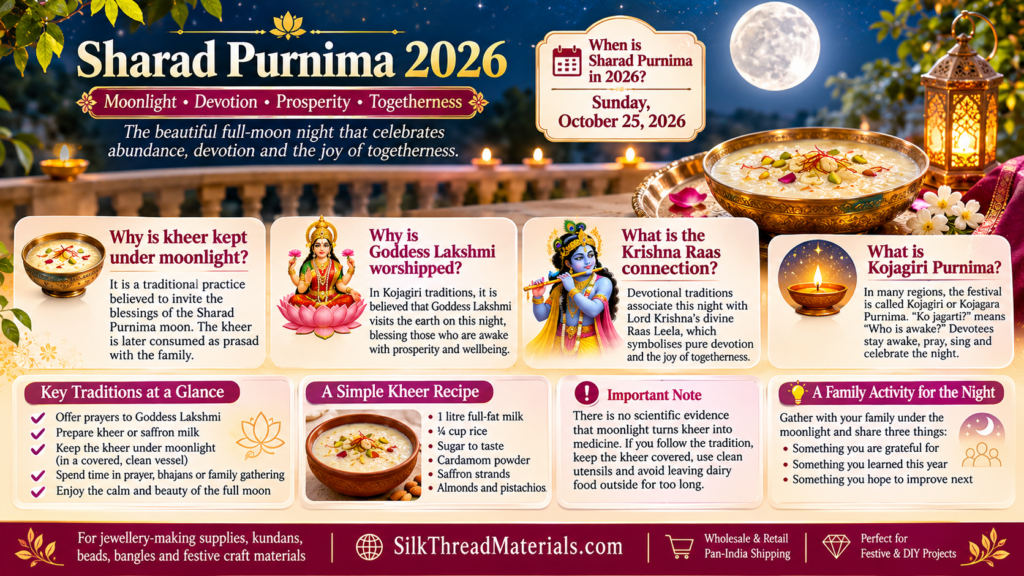
Why is Sharad Purnima also called Kojagiri or Kojagara Purnima?
In several regions, especially Maharashtra and parts of central and eastern India, the festival is known as Kojagiri Purnima or Kojagara Puja.
The traditional idea is connected with Goddess Lakshmi moving through the night and asking:
“Ko jagarti?”
Often interpreted as:
“Who is awake?”
Devotees remain awake, pray, sing, gather with family or participate in community celebrations.
In some traditions, the night therefore becomes associated with vigilance, devotion and prosperity.
The Government of India’s Incredible India portal describes Kojagiri celebrations in Madhya Pradesh that include Maha Aarti, Deepdaan, devotional music, temple rituals and the distribution of saffron-flavoured milk and kheer.
Why is Goddess Lakshmi worshipped on Sharad Purnima?
Sharad Purnima is strongly associated with Goddess Lakshmi in Kojagara traditions.
Lakshmi represents prosperity, abundance, wellbeing and auspiciousness.
But prosperity in Indian religious thought is broader than money alone.
A prosperous household may traditionally be understood as one with food, health, relationships, knowledge, work, stability and generosity.
That gives the festival an interesting message.
Prosperity is not merely about possessing more.
It is also about appreciating what already sustains us.
Food.
Family.
Work.
Knowledge.
Health.
Community.
Sharad Purnima therefore provides a natural moment for gratitude before the much larger Diwali season arrives.
Why is Krishna associated with Sharad Purnima?
Vaishnava traditions connect Sharad Purnima with Lord Krishna’s Maha Raas or Raas Leela.
According to devotional tradition, Krishna performed the divine Raas with the Gopis of Vrindavan on a beautiful full-moon night.
The story has inspired centuries of devotional poetry, music, painting, dance and temple traditions.
Raas Leela should not be understood merely as an ordinary social dance.
Within Bhakti traditions, it represents a much deeper spiritual idea: the soul’s complete devotion toward the divine.
The moonlit setting has consequently become part of the cultural imagination surrounding Krishna.
This connection is one reason Sharad Purnima celebrations in some regions centre strongly on Krishna temples, devotional singing and Raas performances.
Why is kheer kept under the moonlight on Sharad Purnima?
This is probably the most famous household tradition associated with Sharad Purnima.
Families prepare kheer, usually using milk, rice and sugar, or prepare sweetened saffron milk.
The food is then placed under the open night sky or near an area where moonlight can reach it.
Later, it is consumed as prasad.
In traditional belief, the Sharad Purnima moon is considered exceptionally auspicious, and the food exposed to its rays is believed to acquire special qualities.
Some traditions even describe the moonlight metaphorically as carrying amrit, or nectar.
This is a religious and cultural belief.
It should not automatically be converted into a scientific claim.
Does Sharad Purnima moonlight really make kheer medicinal?
This is where many modern explanations become exaggerated.
You may encounter claims saying that moonlight on Sharad Purnima scientifically enriches milk with medicinal energy, increases nutrients, cures diseases or creates special chemical properties.
There is no good scientific evidence demonstrating that simply placing kheer under moonlight produces such medical effects.
Moonlight is reflected sunlight.
It does not transform milk into a medicine.
That does not make the tradition meaningless.
A ritual can have cultural, emotional, spiritual and family significance without needing a laboratory explanation.
Then why might the tradition have developed?
There are several possibilities, but they should be described as interpretations rather than proven historical explanations.
Sharad Purnima occurs after the monsoon period when nights traditionally begin becoming more pleasant in many parts of India.
Families could gather outdoors comfortably.
The full moon created natural illumination in a period long before electric lighting.
Milk-based foods were already culturally valued.
Religious observance, seasonal celebration and community gathering could therefore naturally develop around the full-moon night.
But saying this is different from claiming ancient people scientifically designed the custom to alter the nutritional chemistry of milk.
We simply do not have evidence for that stronger claim.
Is it safe to leave kheer outside all night?
This deserves more attention than it usually gets.
Milk and cooked rice are perishable foods.
Leaving them unrefrigerated outdoors for many hours, particularly in warm conditions, can allow bacteria to multiply.
Outdoor food can also be exposed to insects, dust and contamination.
If your family follows the moonlight tradition, a safer modern approach is to:
Keep the kheer covered.
Use a clean container.
Expose it to moonlight for a reasonable period rather than automatically leaving it outside all night.
Avoid leaving dairy foods for long periods in hot or humid weather.
Refrigerate promptly when appropriate.
Tradition and food safety do not have to conflict.
Why is kheer used instead of another food?
Milk occupies an important place in Indian religious and culinary traditions.
It is used in sweets, temple offerings, abhishekam, festive foods and household rituals.
Rice is equally significant.
Together they create one of India’s oldest and most familiar celebratory foods: kheer.
The ingredients themselves carry powerful associations with nourishment and abundance.
That makes kheer particularly suitable for a festival associated with fullness, prosperity and the moon.
The symbolism works even without claiming supernatural changes to its nutritional composition.
Why do some families prepare masala milk instead?
Kojagiri celebrations in Maharashtra are especially associated with masala doodh, often containing ingredients such as saffron, cardamom, almonds, pistachios and other nuts.
Families and communities may gather outdoors in the evening and share the milk after moonrise.
Public Kojagiri celebrations in Madhya Pradesh also include saffron-flavoured milk and kheer as part of the festivities.
Again, there is considerable regional variation.
One household may prepare kheer.
Another may prepare saffron milk.
Another may perform Lakshmi Puja.
Another may focus mainly on Krishna.
Indian festivals often survive precisely because communities make them their own.
Why is the full moon so important in Indian traditions?
The lunar calendar plays an enormous role in Hindu festival timing.
Many observances occur on Purnima or Amavasya.
The moon also appears repeatedly in Indian mythology, poetry, Ayurveda, agricultural traditions and classical arts.
Before artificial lighting, a full moon had an obvious practical impact too.
A landscape illuminated naturally at night would have felt very different from an ordinary dark evening.
Modern life makes it easy to underestimate that experience because city lights surround us constantly.
Imagine a village centuries ago.
No streetlights.
No phone screens.
No electric bulbs.
Then, once a month, an enormous bright moon lights the landscape.
It is not difficult to understand why cultures around the world created stories, rituals and celebrations around full moons.
Why do some people stay awake on Kojagiri night?
The idea of Jagaran, remaining awake during a sacred night, appears in several Hindu festivals.
In Kojagara traditions, staying awake is linked with devotion to Goddess Lakshmi.
Families may pray, sing bhajans, gather socially or participate in community programmes.
There is an interesting cultural effect here.
Ordinary routines stop.
People who would normally be asleep are together.
The unusual timing itself makes the occasion memorable.
That is part of how festivals create lasting childhood memories.
Sometimes the memory is not the complicated theology.
It is sitting with grandparents under the moon, drinking warm saffron milk at midnight.
Is Sharad Purnima celebrated the same way across India?
No.
This is one of the most important things to remember when learning about Indian festivals.
In Maharashtra, Kojagiri and moonlit milk are prominent.
In parts of eastern India, Kojagara Lakshmi Puja receives greater emphasis.
In Krishna traditions, Sharad Purnima is closely connected with Maha Raas.
In Gujarat, Sharad Poonam may include Garba and community celebrations.
Other households may simply perform puja, prepare kheer and observe the full moon.
There is no need to declare one version the “correct” Sharad Purnima.
Regional variation is part of Indian culture.
What can children learn from Sharad Purnima?
Sharad Purnima gives parents a wonderful opportunity to explain the difference between tradition and scientific evidence.
You can tell children:
“Our tradition says the moonlit kheer is special and we offer it as prasad.”
Then also explain:
“Science does not show that moonlight magically changes the food into medicine.”
Both statements can exist together.
Respecting tradition does not require inventing scientific claims.
And appreciating science does not require dismissing cultural practices.
Teaching children that distinction may actually help them understand their heritage more deeply.
Why is moonlight naturally calming?
Many people describe sitting quietly under a full moon as peaceful.
That experience does not need a supernatural explanation either.
Nighttime environments tend to have fewer visual demands.
The temperature may be cooler.
People may stop working.
Conversation slows.
Phones may be put aside during ritual or prayer.
A bright moon also creates a visually beautiful environment.
All of these factors can contribute to feelings of calm and reflection.
Sometimes the simplest explanation is enough.
A simple Sharad Purnima family activity
After dinner, spend ten minutes outside or near a window where the moon is visible.
Put the phones aside.
Ask each family member to share three things:
Something they are grateful for.
Something they learned during the year.
Something they hope to improve before the next Sharad Purnima.
Children can draw the moon instead.
You can also tell them one Krishna story or explain why Goddess Lakshmi is worshipped on Kojagiri night.
A tradition becomes stronger when children understand why the family is practising it.
Easy Sharad Purnima kheer
A simple rice kheer works beautifully for the festival.
Ingredients
- 1 litre full-fat milk
- ¼ cup rice
- Sugar according to taste
- ½ teaspoon cardamom powder
- A few saffron strands
- Almonds and pistachios
- Raisins, optional
Wash the rice and soak it briefly.
Bring the milk to a gentle boil and add the rice.
Cook slowly while stirring occasionally until the rice becomes soft and the milk thickens.
Add sugar, cardamom and saffron.
Finish with chopped nuts.
Allow the kheer to cool appropriately.
If following the moonlight tradition, transfer it to a clean covered vessel and place it where moonlight can reach it.
Do not leave dairy food uncovered outdoors.
After the ritual, serve it as prasad according to your family tradition.
What is the deeper meaning of Sharad Purnima?
Perhaps the most beautiful idea behind Sharad Purnima is fullness.
The moon appears complete.
The harvest season approaches.
The monsoon has passed.
Families gather.
Food is shared.
Lakshmi represents abundance.
Krishna traditions celebrate divine love.
A simple bowl of kheer becomes something more than dessert because a family has attached memory and meaning to it.
That is how traditions survive.
Not because every ancient belief must be scientifically proven.
But because rituals allow one generation to tell another:
This mattered to our family.
And then the younger generation decides how to carry it forward.
So this Sharad Purnima, enjoy the moon.
Prepare the kheer.
Tell the stories.
Ask questions.
Understand the symbolism.
Keep the food safely covered.
And allow tradition and knowledge to sit together under the same moonlight.