📚 This lesson is part of the STM Creator Academy
Course: Mandala Art Academy
Lesson: 1 of 40
🏠 View the complete Mandala Art Academy course curriculum
Learn what mandala art is, why beginners love it, and how this calming creative hobby can become a handmade income idea from home.
🎓 Lesson 1: What is mandala art? A beginner’s guide to its meaning, benefits and creative possibilities
Mandala art is one of the easiest creative hobbies for beginners to start at home because it does not need expensive tools, professional training, or a perfect drawing background. At its heart, mandala art is built around circles, patterns, balance, repetition and symmetry. For many beginners, it becomes more than a drawing activity because the slow process of creating repeated shapes can feel calming, focused and deeply satisfying. Whether someone wants to learn mandala art as a relaxing hobby, a school project skill, a handmade gifting idea, or even a small home-based creative business, this first lesson will help them understand what mandala art is and why it has become so popular among artists, students, homemakers and creators.
What is mandala art and why do beginners love learning it?
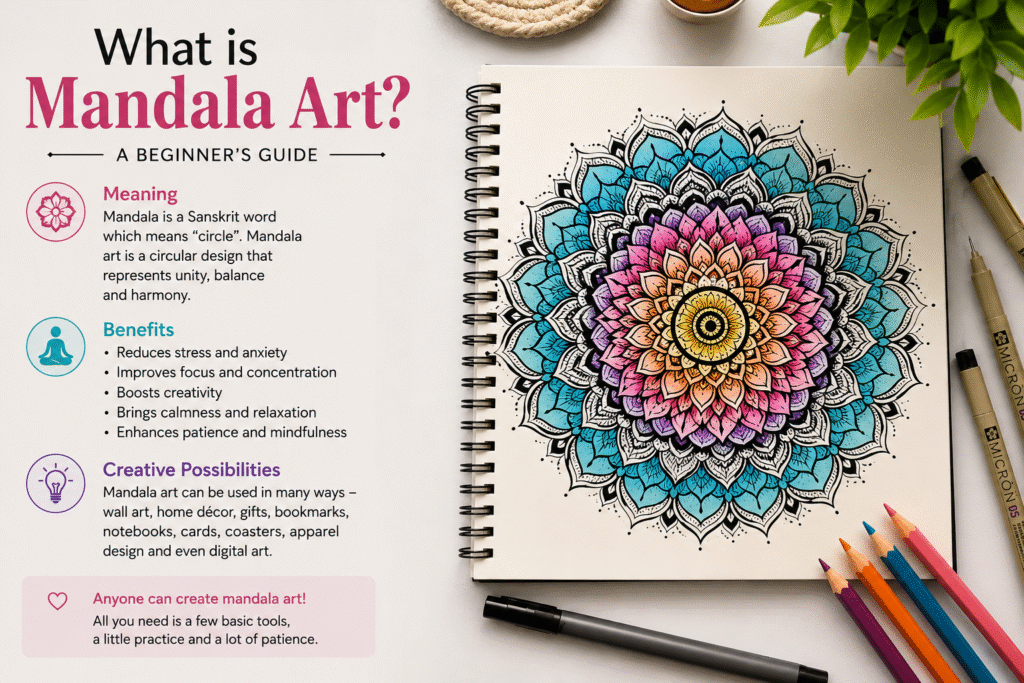
Mandala art is a circular design made using repeated shapes, lines, dots, petals, curves and geometric patterns. The word “mandala” is commonly associated with the idea of a circle, wholeness and balance. In creative practice, mandala art usually begins from a central point and grows outward in layers. Each layer may include simple shapes such as dots, leaves, triangles, arches, flowers, waves or small decorative lines.
The beauty of mandala art is that it looks detailed and impressive, but it can be created using very simple repeated steps. A beginner does not need to draw a perfect flower, face or scenery. Instead, they only need to learn how to repeat small patterns around a circle. This makes mandala art less scary for people who feel they are “not good at drawing.”
For beginners, mandala art is attractive because it gives quick satisfaction. Even a simple black-and-white mandala can look beautiful when completed carefully. As confidence grows, learners can try coloured mandalas, dotted mandalas, floral mandalas, bookmark designs, greeting cards, canvas art, bottle art and wall décor pieces.
Why is mandala art considered calming and relaxing?
Many people enjoy mandala art because it naturally slows the mind down. When you draw repeated shapes in a circular pattern, your attention moves away from distractions and stays with the design. This is why mandala colouring books, dot mandalas and pattern-based art activities are often used as relaxing hobbies.
The process does not demand speed. In fact, mandala art becomes better when it is done slowly. Drawing one layer after another helps beginners focus on small, manageable actions. This can make the activity feel peaceful, especially for people who want a hobby after household work, office work, studies or screen time.
Mandala art is also forgiving. If one pattern is slightly uneven, it can often be balanced by repeating the same style elsewhere. That is a lovely lesson for beginners: art does not always need perfection. It needs patience, rhythm and expression.
What materials are needed to start mandala art at home?
One of the biggest advantages of mandala art is that beginners can start with very basic materials. A plain drawing book or white sheet, pencil, eraser, ruler, compass and black pen are enough for the first few lessons. Later, learners can add fine liners, gel pens, brush pens, colour pencils, acrylic colours, dotting tools and canvas boards.
For the very first practice, do not worry about expensive supplies. A simple pen and paper are enough to understand circles, grids and repeated patterns. Once you enjoy the process, you can slowly invest in better materials.
In the next lesson, we will create a complete mandala art materials list for beginners, including budget-friendly options and optional advanced tools.
Who can learn mandala art?
Mandala art can be learned by almost anyone. Children can use it for school projects and creative activities. Homemakers can use it as a peaceful hobby or handmade gifting skill. Students can use it for art files, bookmarks and decoration. Teachers can use mandala activities in classrooms. Adults can use it as a mindful break from daily stress. Creators can turn it into products such as wall frames, greeting cards, bookmarks, phone covers, notebooks, coasters and digital designs.
It is also a good starting point for people who want to build confidence before learning other art forms such as doodling, zentangle, dot painting, calligraphy, bottle art or canvas painting.
Can mandala art become a home-based income idea?
Yes, mandala art can become a small income idea when the artist develops skill, consistency and a clear product style. Beginners should first focus on learning, practicing and improving their designs. Once they are confident, they can create products such as handmade bookmarks, greeting cards, framed artwork, wall plates, canvas paintings, customized name mandalas, wedding gifts, return gifts and digital printable designs.
Mandala art can be sold through Instagram, WhatsApp, local exhibitions, school fairs, craft stalls, Etsy-style platforms and customized gifting pages. However, earning from mandala art requires more than drawing. A creator must also learn pricing, packaging, product photography, customer communication and social media branding.
That is why STM Creator Academy will not stop at tutorials. In later lessons, we will also cover how to sell mandala art from home and how to build a small creative brand around it.
Beginner practice activity for today
For today’s lesson, take a plain sheet of paper and draw one small circle in the centre. Around that circle, draw simple dots. Around the dots, draw small petals. Around the petals, draw tiny lines. Do not worry about perfection. The goal is only to understand how a mandala grows from the centre outward.
Spend 15 minutes on this activity. Your first mandala does not need to be beautiful. It only needs to begin.
What will you learn in the next lesson?
In Lesson 2 of Mandala Art Academy, we will cover the complete mandala art materials list for beginners. You will learn which tools are necessary, which ones are optional, what to buy first, and how to start mandala art at home without spending too much money.
Share your artwork with STM
Finished your first practice mandala? We would love to see it.
Share your artwork with STM and inspire other beginners who are starting their creative journey. Every artist begins with one circle, one line and one small attempt. Your first design may encourage someone else to begin too.
Continue your learning
Previous: Mandala Art Academy (Course Overview)
Next Lesson: Mandala art materials list: Everything you need before drawing your first mandala
🎨 Share your artwork
Have you completed today’s practice?
We’d love to see your first mandala!
📸 Share your artwork on Instagram: @jewellerymakingmaterials
📧 Or email it to us (pallavi.rags@gmail.com).
Use #STMCreatorAcademy so we can feature your work and inspire other creators.
Support the free Mandala Art Academy
Learning mandala art with us? The Mandala Art Academy is completely free, and every contribution helps us create more step-by-step lessons, practice guides and original tutorial images.
Even a small contribution helps us continue the next lesson.
For supporters in India
Scan the QR code below or use the UPI ID to contribute any amount you are comfortable with.

UPI ID: pallavi.rags-1@okhdfcbank
Pay securely through Razorpay
Prefer to pay by card or another supported online payment method? Use our secure Razorpay page below. Indian and international cards are accepted.
Support Mandala Art Academy and help create the next free lesson
Your support is entirely optional. Every Mandala Art Academy lesson will remain free for everyone.
Thank you for learning with us and helping us create the next lesson. ❤️