Learn what candle making is, why handmade candles are popular, what beginners need to know, and how to start safely with STM Creator Academy.
Course: STM Creator Academy Candle Making Course
Lesson: 1 of 30
Skill level: Beginner
What is candle making?
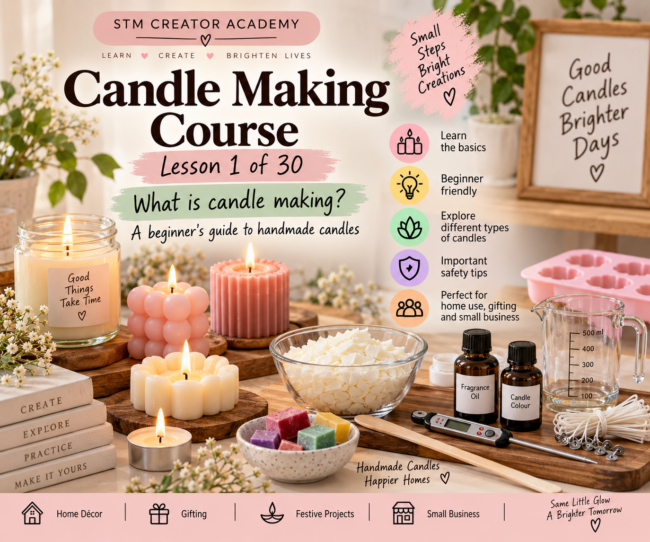
Candle making is the creative process of turning wax, wick, colour, fragrance and decoration into a finished candle that can be used for home décor, gifting, festivals or small business selling. A candle may look simple from the outside, but a good handmade candle depends on the right balance of wax type, wick size, fragrance quantity, container, temperature and safety.
For beginners, candle making is a beautiful craft because it is both useful and creative. You can make simple candles for your home, decorative candles for festivals, scented candles for relaxation, diya candles for Diwali, or gift sets for friends and family. As you practise more, you can also explore candle making as a small home-based business.
This course will help you learn candle making step by step. Instead of rushing into advanced designs, we will first understand the basics clearly so that your candles look good, burn safely and feel professional.
Why is candle making a good skill to learn?
Candle making is a beginner-friendly craft because it does not require drawing skills or complicated tools in the beginning. With the right guidance, you can start with simple candles and slowly move into decorative, scented and festive designs. It is also a relaxing activity because the process involves choosing colours, fragrances, moulds and finishing styles.
Handmade candles are also popular for gifting. People use candles for birthdays, return gifts, weddings, housewarming gifts, festive hampers, puja decoration and home décor. During festivals like Diwali, handmade candles and diya candles can become beautiful products for gifting and small business orders.
For small handmade sellers, candle making has good potential because candles can be created in many styles and price ranges. You can sell single candles, candle jars, festive sets, wax melts, return gift packs or premium decorated candles depending on your audience.
Types of handmade candles beginners can explore
There are many types of candles, but beginners should first understand the common categories. Each candle type needs different materials and slightly different techniques.
Jar candles are candles poured into glass jars, tins or containers. These are popular for scented candles, home décor and gifting.
Pillar candles are free-standing candles that hold their shape after removing from the mould. These need firmer wax and proper wick selection.
Mould candles are made using silicone or plastic moulds. They can be shaped like flowers, bubbles, hearts, diyas, gods, animals or decorative objects.
Tealight candles are small candles usually placed in aluminium cups or small holders. They are simple and useful for decoration, puja and festive lighting.
Diya candles are festival-style candles used especially for Diwali, puja decoration and return gifts. They can be simple, coloured, scented or decorated.
Wax melts are scented wax pieces without a wick. They are used with wax warmers and are a good beginner product once fragrance basics are understood.
Gel candles are transparent candles made with gel wax. They often include decorative elements, but they need careful handling and proper safety understanding.
What do you need to start candle making?
Beginners do not need to buy everything at once. In the beginning, you only need to understand the basic materials and slowly choose what is required for your first project.
The main supplies used in candle making are wax, wicks, containers or moulds, fragrance oils, candle colours, a melting pot, thermometer, stirring stick, weighing scale and safety tools. Depending on the type of candle, you may also need wick stickers, wick holders, labels, packaging materials and decorative items.
The most important thing is not to buy random supplies without knowing their purpose. Candle making works best when you choose materials based on the candle you want to make. For example, a jar candle needs a suitable container wax and wick, while a mould candle needs wax that can hold shape after cooling.
Is candle making easy for beginners?
Candle making is easy to start, but it needs patience and safety. Beginners sometimes think candle making is only about melting wax and pouring it into a mould, but good candles need testing. The wax should melt properly, the wick should be centred, the fragrance should be added at the right stage, and the candle should be allowed to cool correctly.
The first few candles may not be perfect, and that is completely normal. You may see issues like cracks, uneven tops, weak fragrance, tunnelling, sinking, air bubbles or wick problems. These are common beginner mistakes, and we will learn how to avoid them in later lessons.
The goal of this course is to help you build confidence slowly. Start with simple candles, understand the materials, practise safely and improve with each project.
Important safety reminder
Candle making involves hot wax, heat sources and sometimes fragrance oils or colours, so safety is very important. Always work in a clean and stable area, keep children away from hot wax, and never leave melting wax unattended. Use heat-safe containers and avoid overheating wax.
If children are participating in candle-related crafts, an adult should handle all melting, pouring and flame-related steps. Handmade candles should also be tested safely before gifting or selling. A beautiful candle should not only look good, it should also be safe to use.
What will you learn in this candle making course?
In this course, you will learn candle making from the basics. We will cover candle wax types, wick selection, melting wax, adding colour, adding fragrance, preparing moulds and jars, and avoiding common beginner mistakes.
After that, we will move into simple projects like moulded candles, jar candles, tealights, diya candles and wax melts. As the course continues, you will also learn decorative candles, layered candles, flower candles, gel candles, festive candle gift sets, packaging, pricing, selling and building a small candle brand from home.
By the end of the course, you should be able to understand what materials to use, how to practise safely, how to create beautiful candles and how to present them for gifting or selling.
Beginner practice task
Before buying or making your first candle, take a notebook and write down the type of candles you want to learn first. Choose any three from this list:
Jar candles
Diya candles
Tealight candles
Mould candles
Scented candles
Wax melts
Decorative candles
Festival gift candles
Then write why you want to make them. Your reason may be home décor, Diwali gifting, return gifts, relaxation, handmade business or creative learning. This will help you choose the right materials in the next lesson.
Lesson 1 takeaway
Candle making is a creative and useful handmade skill that can be learned step by step. Beginners should start by understanding the basics of wax, wicks, candle types and safety before trying advanced designs.
In the next lesson, we will look at the essential candle making supplies for beginners and understand what each item is used for.
Course progress: 1/30 lessons completed.
Support STM Creator Academy
STM Creator Academy creates free step-by-step courses, beginner-friendly tutorials and creative learning resources. If our lessons have helped you, you can support our work with any contribution you are comfortable with.
For supporters in India
Scan the QR code below or use the UPI ID to contribute any amount.

UPI ID: pallavi.rags-1@okhdfcbank
Pay securely through Razorpay:
Prefer card or another supported payment method? Use our Razorpay support page.
Your support is completely optional and helps us create more free lessons, original tutorial images, practice guides and future creative courses.
Our free course lessons will remain accessible to everyone.