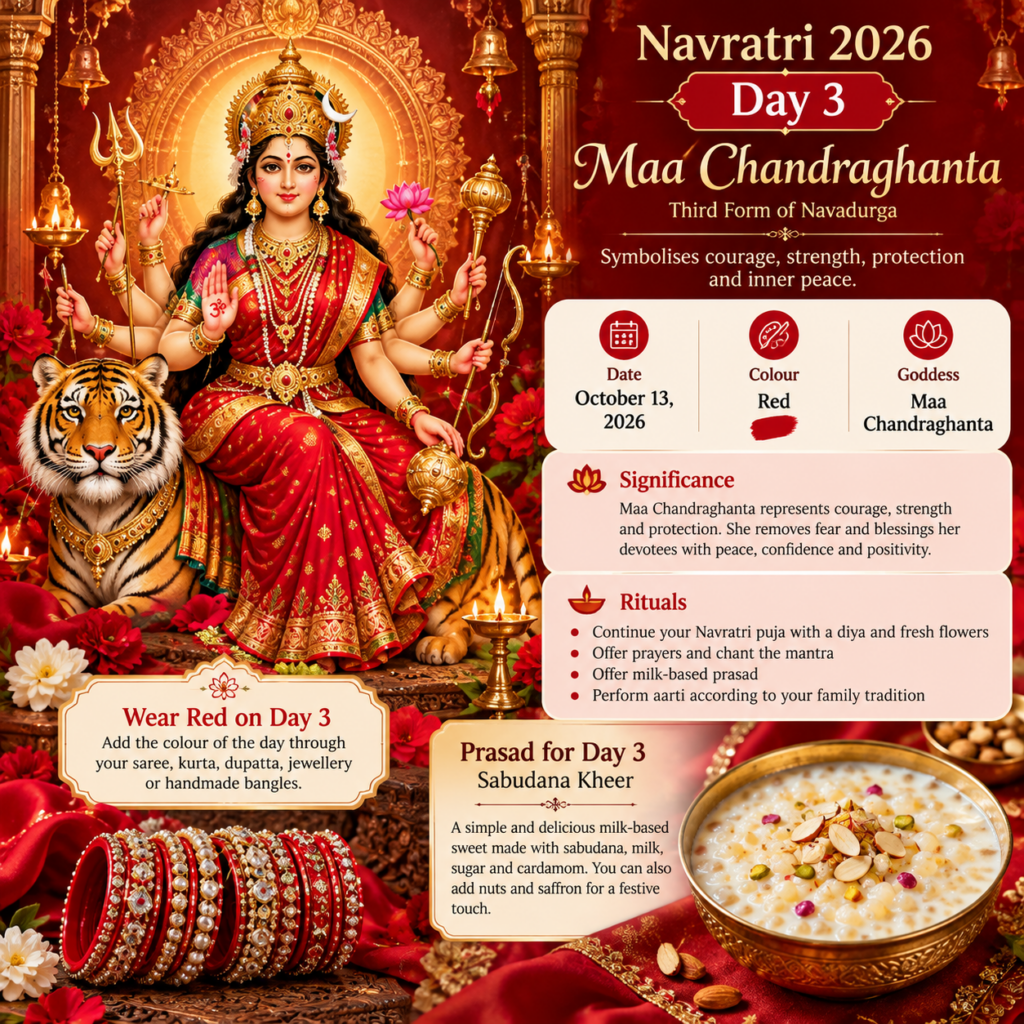
Navratri Day 3 falls on Tuesday, October 13, 2026, and is dedicated to Maa Chandraghanta, the third form of Goddess Durga. The colour traditionally followed for the third day of Sharad Navratri 2026 is Red, a vibrant shade associated with strength, energy and devotion.
Maa Chandraghanta represents courage combined with inner peace. Her form is powerful, yet she is also worshipped as a compassionate mother who gives devotees the confidence to face challenges with determination.
Who is Maa Chandraghanta and what does her form signify?
The name Chandraghanta comes from the crescent moon on the Goddess’s forehead, which is traditionally described as resembling a bell or ghanta. She is commonly depicted riding a tiger, carrying weapons as well as a lotus, symbolising both strength and grace.
Maa Chandraghanta is worshipped as a powerful form of Goddess Durga associated with courage, protection and peace. Her appearance reminds devotees that strength does not always have to be aggressive. True strength can also mean remaining calm, disciplined and confident while facing difficulties.
For families observing all nine days of Navratri, Day 3 can therefore be a meaningful time to pray for courage, emotional balance and the ability to overcome fear.
What is the Navratri Day 3 colour in 2026?
The Navratri colour for October 13, 2026 is Red. Red is traditionally associated with energy, power, passion and devotion and makes Day 3 one of the most vibrant days in the nine-colour Navratri sequence.
You can incorporate red through your saree, lehenga, kurta, dupatta, flowers, jewellery or bangles.
Red silk-thread bangles embellished with kundans, pearls, gold-toned stones or floral elements can create a rich festive combination for puja, garba and dandiya celebrations.
How can Maa Chandraghanta be worshipped on Navratri Day 3?
Begin by cleaning your puja space and continuing the Navratri setup established during the first two days. Light a diya and incense according to your family’s tradition and offer fresh flowers, fruits and naivedya to Maa Chandraghanta.
Devotees may offer prayers, perform aarti or chant the simple mantra:
Om Devi Chandraghantayai Namah
Religious practices vary across regions and families, so there is no requirement to replace your family’s traditional puja method with a different procedure found online.
The most important part of the worship is devotion and maintaining the spiritual discipline followed throughout Navratri.
What prasad is offered to Maa Chandraghanta?
Milk, kheer and sweets prepared from milk are traditionally associated with the bhog offered to Maa Chandraghanta on Navratri Day 3.
Since we prepared Makhana Kheer for Day 1 and Mawa Barfi for Day 2, today’s recipe can be another simple Navratri favourite: Sabudana Kheer.
Sabudana kheer requires only a few ingredients, has a soft creamy texture and can also suit many household Navratri fasting traditions.
Easy Sabudana Kheer recipe for Navratri Day 3 prasad
Ingredients
- ½ cup sabudana or tapioca pearls
- 1 litre milk
- 4 to 5 tablespoons sugar, or according to taste
- ½ teaspoon cardamom powder
- 1 tablespoon ghee, optional
- 8 to 10 cashews
- 8 to 10 almonds
- A few pistachios, optional
- A few saffron strands, optional
How to make Sabudana Kheer
Wash the sabudana thoroughly until the water becomes mostly clear. Soak it in sufficient water for around 30 minutes to one hour, depending on the variety you are using.
Bring the milk to a gentle boil in a heavy-bottomed pan and reduce the flame. Drain the soaked sabudana and add it to the milk.
Cook slowly while stirring regularly so that the sabudana does not stick to the bottom of the pan. As it cooks, the pearls will gradually become soft and translucent.
Add sugar and cardamom powder and continue cooking for a few more minutes.
If you are using cashews, almonds, pistachios or saffron, add them toward the end. You can lightly roast the nuts in a little ghee before adding them for extra flavour.
Switch off the flame when the kheer reaches a creamy consistency. Remember that sabudana kheer tends to thicken further as it cools.
Keep a portion separately in a clean bowl for the Goddess before serving it to the family.
After the puja is completed according to your household tradition, distribute the kheer as prasad.
Simple Navratri Day 3 puja checklist
For a peaceful home puja, keep everything ready before beginning.
Depending on your family custom, you may prepare:
- Maa Durga or Maa Chandraghanta image or idol
- Diya
- Incense
- Fresh flowers
- Kumkum
- Akshat
- Fruits
- Water
- Milk-based prasad
- Kalash established on Day 1, if applicable
Families observing a Navratri fast should continue following their own household rules regarding grains, salt and permitted ingredients.
What can Maa Chandraghanta teach us on Day 3?
Maa Chandraghanta’s significance can also be understood as a lesson in courage with calmness.
There are times when strength means taking action, speaking up or protecting what matters. At other times, strength means staying composed instead of reacting immediately.
On Day 3, you can take a few minutes to think about one fear or challenge you would like to face with greater confidence.
Ask yourself:
What would I do differently if I approached this situation with courage instead of fear?
A simple reflection like this can add personal meaning to the day’s spiritual observance.
Complete your Navratri Day 3 look with Red
Since Red is the colour for Navratri Day 3 in 2026, it is a beautiful day for rich festive styling.
A red saree, lehenga, salwar suit or kurta can be paired with gold-toned jewellery, kundans, pearls and matching handmade bangles.
At Silk Thread Materials, Navratri silk-thread bangles can be prepared in Red as well as the complete set of nine Navratri colours.
Designs can include kundans, stones, pearls, floral embellishments and festive combinations depending on availability.
Because handmade pieces require preparation time, advance Navratri orders are recommended.
Visit SilkThreadMaterials.com or DM @jewellerymakingmaterials for advance orders and enquiries.