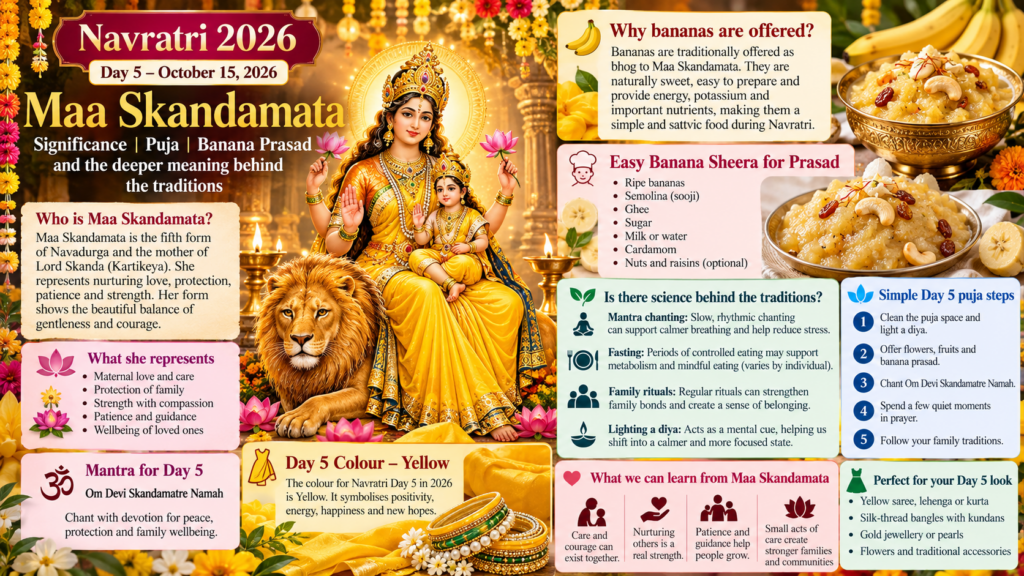
Navratri Day 5 falls on Thursday, October 15, 2026, and is dedicated to Maa Skandamata, the fifth form of Navadurga. The widely followed colour for Day 5 of Sharad Navratri 2026 is Yellow, while bananas are traditionally offered as bhog to Maa Skandamata.
The fifth day has a particularly tender significance because Maa Skandamata represents Goddess Parvati in her role as the mother of Lord Skanda, also known as Kartikeya or Murugan. While some forms of Durga emphasise battle, austerity or fierce protection, Skandamata brings attention to another kind of strength: the protective, patient and nurturing power associated with motherhood.
For families celebrating Navratri, Day 5 can therefore become more than another day of puja. It is an opportunity to reflect on care, family responsibility, emotional security, patience and the strength required to nurture another person.
Who is Maa Skandamata and why is she worshipped on the fifth day?
The name Skandamata literally means the mother of Skanda. Traditional iconography shows the Goddess carrying child Skanda in her lap while seated on or associated with a lion. She is depicted with four hands, carrying lotus flowers in her upper hands, holding the child and displaying the Abhaya Mudra, a gesture associated with reassurance and protection.
This imagery combines two qualities that may initially appear opposite: gentleness and strength.
The child in her lap represents nurturing care and responsibility, while the lion represents courage and power. Together, they convey an important idea found repeatedly in Indian traditions: compassion does not require weakness, and strength does not require harshness.
For parents in particular, Maa Skandamata can carry special emotional significance. Raising and protecting a child requires tenderness, but it also requires discipline, courage, sacrifice and the ability to make difficult decisions.
What is the Navratri Day 5 colour in 2026?
The colour followed for Navratri Day 5 on October 15, 2026 is Yellow. The 2026 Navratri colour sequence places Yellow after Royal Blue on Day 4 and before Green on Day 6.
Yellow naturally gives the day a bright and cheerful appearance. Many devotees incorporate the colour through sarees, salwar suits, kurtas, dupattas, flowers, bangles or jewellery.
The colour tradition is widely enjoyed during Navratri, but it should be understood as a festive custom rather than a compulsory rule followed identically everywhere in India. Regional practices and family traditions can differ considerably.
For a Day 5 look, yellow silk-thread bangles can pair beautifully with pearls, gold-toned kundans, white stones or floral elements.
What does Maa Skandamata represent?
Maa Skandamata is often associated with maternal love, compassion, protection and family wellbeing. Traditional Day 5 worship therefore frequently centres on prayers for children, peace within the household and the wellbeing of loved ones.
But the symbolism can be understood more broadly.
Not everyone is a parent, yet everyone experiences relationships in which they care for, guide or support someone else. That could be a younger sibling, a friend, an elderly parent, a student, a colleague or even a community.
Seen in this way, Day 5 can encourage us to think about responsible care. Are we helping people become stronger and more independent, or simply controlling them? Are we patient when someone is learning? Are we present when somebody needs support?
These questions make an ancient religious symbol surprisingly relevant to everyday life.
How can Maa Skandamata be worshipped on Navratri Day 5?
Families who established a Kalash during Ghatasthapana on the first day generally continue their Navratri worship at the same puja space.
Begin by cleaning the area and arranging the items required according to your household tradition. Light a diya, offer flowers, fruits and the prepared bhog, and spend a few quiet moments in prayer.
A commonly recited mantra is:
Om Devi Skandamatre Namah
The aim does not have to be an elaborate ceremony. For many people, repeating the mantra slowly, sitting quietly and focusing their attention on the puja can itself create a meaningful break from the speed and distraction of everyday life.
Family customs should always take precedence over a generic online ritual guide. Navratri is celebrated in many different ways across India, and those variations are part of the richness of the festival.
Why do we light a diya during puja?
Spiritually, the diya is one of the most familiar symbols of Indian worship. Light represents knowledge, hope and awareness, while darkness is often used metaphorically for ignorance or confusion.
There is also a simple psychological dimension to lighting a lamp before prayer. Performing the same physical action at the beginning of a ritual can act as a mental cue, signalling that ordinary activity has stopped and a period of focused attention has begun.
This does not mean science has proved that the diya was originally invented as a psychological technique. Rather, modern understanding of habits and rituals helps explain why repeated sensory cues such as lighting a lamp, sitting in a particular place or beginning with the same prayer can help people shift into a calmer, more attentive state.
Is there science behind chanting mantras?
This is an area where it is important to be precise.
Science cannot test or confirm the spiritual blessings attributed to a mantra. However, researchers have studied the physical act of rhythmic chanting and slow breathing.
A study examining rhythmic prayer and mantra recitation found that reciting phrases at a slow rhythm could reduce breathing frequency and influence cardiovascular rhythms and baroreflex sensitivity. More recent research has also examined changes in breathing and autonomic activity during different styles of mantra chanting.
So when a person sits quietly and repeats a mantra slowly, part of the calming experience may come from controlled breathing, repetition, focused attention and reduced mental distraction.
That does not replace the spiritual meaning of the mantra. It simply shows that devotional practices can simultaneously have religious meaning and measurable effects on how the body is breathing and regulating attention.
Why is fasting such an important part of Navratri?
Many devotees observe some form of fasting or dietary restriction during Navratri. The exact rules vary enormously between families and regions, ranging from complete fasting to avoiding grains or eating only certain foods.
Religiously, fasting is generally associated with discipline, devotion and reducing attachment to ordinary comforts.
Modern research on intermittent fasting and time-restricted eating has found possible benefits for weight, insulin regulation and some metabolic markers in particular groups. However, researchers also stress that results vary and that religious fasting practices are not identical to the fasting protocols studied in clinical trials.
So it would be incorrect to claim that Navratri fasting automatically “detoxes” the body or cures disease.
A more responsible interpretation is that periods of controlled eating can change metabolism, while the traditional practice also encourages self-control and mindful eating.
Pregnant women, children, elderly people and anyone with diabetes, eating disorders or other medical conditions should follow appropriate medical advice rather than feeling pressured to fast.
Why are bananas offered to Maa Skandamata?
Bananas are traditionally associated with the Day 5 bhog for Maa Skandamata. They may be offered directly as fruit or used to prepare a simple sweet prasad.
From a practical point of view, bananas are naturally sweet, easy to serve, widely available and require very little preparation.
They also provide carbohydrates along with nutrients such as potassium and vitamin B6. That makes them a convenient food, particularly during periods when a person may be eating a more restricted Navratri diet.
Again, the nutritional qualities of bananas should not be confused with the religious reason for offering them. The bhog is primarily a devotional tradition; nutrition simply helps us understand why fruit is also a practical food during festival fasting.
Easy Banana Sheera recipe for Navratri Day 5 prasad
For Day 5, you can offer fresh bananas directly or prepare a simple Banana Sheera.
You will need:
- 2 ripe bananas
- ½ cup semolina or sooji
- 2 tablespoons ghee
- ½ cup sugar, adjusted to taste
- About 1½ cups milk or water
- ½ teaspoon cardamom powder
- Cashews, almonds or raisins if desired
- A few saffron strands, optional
If your household follows a vrat that does not permit semolina or particular grains, do not use this version. Follow the ingredients traditionally permitted in your family instead.
Heat the ghee gently in a pan and add the semolina. Roast it over low heat, stirring continuously, until it becomes aromatic and lightly golden.
In another vessel, warm the milk or water. Carefully add it to the roasted semolina while stirring continuously to prevent lumps.
Once the mixture begins to thicken, add the sugar and cardamom powder.
Mash the ripe bananas separately and add them once the sheera has cooked and softened. Mix gently and cook for another minute or two.
Add roasted nuts, raisins or saffron if desired.
Keep a portion in a clean bowl for naivedya before serving the rest of the family. After completing the puja according to your family tradition, distribute it as prasad.
Why do festivals use food as part of worship?
Food is one of the most powerful ways cultures preserve memory.
A child may forget the exact words of a ritual but remember the smell of a particular sweet prepared by a grandmother every Navratri. Over time, recipes become connected with family, place, season and identity.
Preparing prasad also turns worship into participation. Instead of simply observing a ceremony, family members clean, cook, arrange, offer and share food together.
The final act of distributing prasad reinforces another important cultural idea: something offered with devotion is eventually shared.
Why do repeated family rituals remain meaningful?
One reason traditional festivals survive for generations is repetition.
The same songs, foods, lamps, flowers and prayers return year after year. Children watch adults performing them and gradually begin participating themselves.
Modern psychology recognises that predictable family rituals can contribute to a sense of continuity, belonging and shared identity. The value of a ritual is therefore not limited to whether every individual action has a measurable biological benefit.
Sometimes the deeper benefit is simply that people stop, gather and do something meaningful together.
That can be particularly important today, when family members may spend much of their day in separate rooms, workplaces, schools or digital environments.
What can we learn from Maa Skandamata on Day 5?
The image of Maa Skandamata holding her child while remaining powerful enough to ride a lion offers a simple lesson: care and courage can exist together.
Day 5 can therefore be a good time to think about the people who depend on us and the people who have supported us.
Ask yourself:
Who has quietly protected, taught or encouraged me, and when was the last time I thanked them?
You could also think about someone who currently needs your patience rather than your criticism.
That small reflection can turn the festival from something we merely perform into something that influences how we behave.
Celebrate Navratri Day 5 with Yellow
Yellow brings a bright, joyful character to the fifth day of Navratri.
A yellow saree, lehenga, salwar suit or kurta can be paired with gold jewellery, pearls or contrasting green and red details. Yellow silk-thread bangles decorated with kundans or white stones can also complement the Day 5 colour beautifully.
Whether the celebration is elaborate or simple, the deeper message of Maa Skandamata remains relevant: strength can protect, compassion can guide and nurturing another person is itself a powerful responsibility.