Navratri evenings across India and Indian communities around the world are filled with colourful clothes, music, clapping, circular dance formations and the rhythmic sound of decorated sticks striking each other. Two names are heard again and again during these celebrations: Garba and Dandiya.
They are often mentioned together and are frequently performed at the same Navratri event, but Garba and Dandiya are not exactly the same dance. They developed with different movements, symbolism and performance styles, even though both have become closely connected with the worship and celebration of Goddess Durga during Navratri.
Understanding the difference makes the celebration even more meaningful because these dances are not simply entertainment. They bring together devotion, physical movement, music, community participation and cultural memory.
What is Garba?
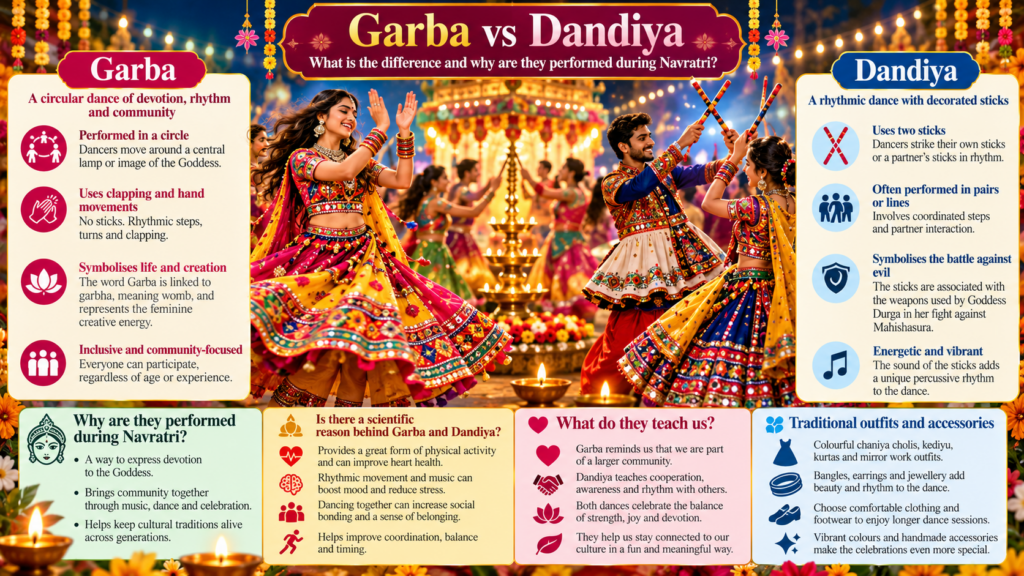
Garba is a traditional folk dance strongly associated with Gujarat and the Navratri festival. Participants usually dance in a circle around a central sacred arrangement, which may include a lamp, an image or representation of the Goddess, or another devotional focal point.
Traditional Garba movements involve rhythmic steps, clapping, turning and coordinated movement with the group. The dance often begins relatively slowly and becomes faster as the music builds.
The word Garba is commonly linked with the Sanskrit word garbha, meaning womb. This has contributed to the traditional interpretation of Garba as representing life, creation and the feminine creative principle.
The circular movement around the centre also carries powerful symbolism. Individual dancers keep moving, but the centre remains constant, creating a visual reminder of continuity and the idea of divine energy at the heart of life.
What is Dandiya?
Dandiya, often called Dandiya Raas, is another traditional dance closely associated with Gujarat and Navratri celebrations.
The biggest visual difference is easy to recognise: participants perform Dandiya using two decorated sticks, generally one in each hand. Dancers strike their own sticks or those of a partner in rhythm while moving through coordinated steps and changing partners or positions.
The dance can involve two lines, pairs or larger circular formations. Like Garba, the music often becomes faster and more energetic as the celebration continues.
Dandiya therefore creates a more percussive performance because the sound of the sticks becomes part of the rhythm.
Garba vs Dandiya: what is the main difference?
The easiest way to remember the difference is:
Garba primarily uses clapping, hand movements and circular steps, while Dandiya uses decorated sticks as part of the dance.
Garba is generally performed around a central devotional element and places strong visual emphasis on circular movement. Dandiya is more strongly associated with partner interaction, coordinated stick movements and rhythmic striking.
Modern Navratri celebrations often combine the two. An evening may begin with traditional Garba and later move into faster Dandiya Raas, which is one reason people sometimes use the terms interchangeably.
Why is Garba danced in a circle?
The circle is one of the most distinctive features of Garba.
Spiritually, the centre of the circle is traditionally associated with the Goddess or divine energy, while the dancers move continuously around it. The formation can be understood as a reminder that individual lives and circumstances are always changing while the divine principle remains at the centre.
The circular formation also has a practical social effect. Unlike a performance in which a small number of dancers face an audience, Garba allows large groups of people to participate together.
There is no obvious “front” or “back” of the circle. Everyone becomes part of the same moving formation.
That may be one reason Garba feels so inclusive when performed in a community setting.
What do the Dandiya sticks represent?
Different traditional interpretations are associated with Dandiya sticks.
One widely repeated explanation connects the sticks with the weapons used in the symbolic battle between Goddess Durga and Mahishasura. In that interpretation, Dandiya Raas reflects the energy and rhythm of a divine battle between good and destructive forces.
The sticks are therefore not merely decorative accessories in the traditional understanding of the dance.
At the same time, modern Dandiya events also emphasise celebration, friendship, music and social interaction. Many participants may enjoy the dance without consciously thinking about its symbolic origins every time they strike the sticks.
That does not diminish the tradition. Cultural practices often carry several layers of meaning at the same time.
Why are Garba and Dandiya associated with Navratri?
Navratri celebrates different forms of the Goddess across nine nights, and community gatherings have long been an important part of the festival in many regions.
In Gujarat, Garba and Dandiya became powerful expressions of this celebration through music, dance and collective participation.
The dances allow devotion to move beyond a quiet individual ritual. Instead of worship being limited to the puja room, people participate through movement, song, traditional clothing and community gatherings.
That combination helps explain why Navratri nights can feel simultaneously religious, cultural and festive.
Is there a scientific reason behind Garba and Dandiya?
It would be misleading to claim that Garba or Dandiya was originally designed as a scientific exercise programme. Their origins are cultural and devotional.
However, modern exercise science helps us understand some of the physical benefits that naturally arise from performing these dances.
Garba and Dandiya involve repeated walking, stepping, turning, arm movement, clapping and coordination. Depending on speed and intensity, a long dance session can become a form of moderate or vigorous physical activity.
This kind of continuous rhythmic movement can increase heart rate, involve large muscle groups and contribute to overall physical activity.
So while the festival dances were not invented as modern cardio workouts, participating actively can certainly provide exercise.
Why can group dancing make people feel happier?
Anyone who has attended a successful Garba night will recognise the emotional energy of hundreds of people moving to the same rhythm.
Modern psychology and neuroscience have studied how music, coordinated movement and social interaction can influence mood and feelings of connection.
Moving together in rhythm can increase a sense of social bonding. Music can affect emotion and motivation, while physical activity itself is associated with improvements in mood for many people.
This helps explain why a Garba or Dandiya gathering can leave participants feeling energised even after considerable physical effort.
Again, this does not prove that the tradition was created specifically to produce these physiological effects. It simply shows that ancient communal practices can have benefits that modern science is capable of describing.
Why does rhythmic movement feel so natural?
Human beings respond naturally to rhythm.
When music provides a predictable beat, the brain can coordinate movement with that pattern. This process is sometimes described as rhythmic entrainment.
In Garba and Dandiya, repeated step sequences make it possible for large groups to synchronise their movement even when participants have different levels of dance experience.
This repetition also makes the dance easier to learn. A beginner can gradually recognise the rhythm, copy the people nearby and become part of the group.
That may be one reason these traditions continue to attract participants across generations.
Can Garba improve coordination and balance?
Garba frequently requires dancers to move forward and backward, turn, clap, change direction and remain aware of the people surrounding them.
Dandiya adds another layer because participants must also coordinate their hands, sticks and partner movements while maintaining the rhythm.
These actions involve balance, timing, spatial awareness and hand-eye coordination.
For experienced dancers, the movements may appear effortless. For beginners, however, learning even a basic Dandiya sequence demonstrates how much coordination the dance actually requires.
Why are traditional clothes such an important part of Garba nights?
Garba and Dandiya are visual celebrations as much as musical ones.
Traditional Gujarati Garba clothing is known for vivid colours, mirror work, embroidery, beads and decorative detailing. Women commonly wear chaniya cholis or other festive outfits, while men may wear kediyu-style garments or colourful kurtas.
Jewellery, bangles and accessories amplify the effect of movement.
When a dancer turns, embroidered fabric, mirrors, earrings and bangles all catch and reflect light. Clothing therefore becomes part of the visual rhythm of the dance rather than simply something worn to the event.
Why are bangles especially suited to Garba and Dandiya?
Bangles naturally complement rhythmic hand movement.
During Garba, repeated clapping and arm movements make stacked bangles visible throughout the dance. During Dandiya, the hands are even more prominent because dancers are continuously moving and striking their sticks.
Colourful silk-thread bangles, kundan bangles and lightweight festive designs can therefore become an important part of the overall Navratri look.
Comfort matters as well. Extremely heavy jewellery may become uncomfortable during long dance sessions, so many dancers prefer a combination of statement pieces and lighter accessories.
Why do communities continue organising Garba nights outside India?
Garba has travelled far beyond Gujarat.
Indian communities in the United States, United Kingdom, Canada, Australia, the Middle East and many other regions now organise large Navratri Garba and Dandiya events.
For families living away from India, these gatherings serve another important function: cultural continuity.
Children who may not experience large traditional festivals in their everyday surroundings get an opportunity to wear Indian clothing, hear regional music, learn dances and participate alongside parents and grandparents.
In this way, Garba becomes both a celebration and a way of teaching culture through participation.
Why do younger generations enjoy Garba so much?
Many traditions struggle when younger people experience them only as obligations.
Garba and Dandiya have an advantage because participation can be genuinely enjoyable.
There is music, fashion, friendship, movement, photography, food and community interaction. Young people can participate socially while still remaining connected with a traditional celebration.
Modern Garba music has also evolved, mixing traditional compositions with contemporary arrangements and performance styles.
The tradition therefore adapts without completely losing its identity.
What is the deeper lesson behind Garba?
Garba places the individual inside a larger circle.
Everyone has their own clothes, steps, style and personality, yet the dance works only when participants remain aware of the rhythm and the people around them.
That makes Garba a beautiful metaphor for community life.
We remain individuals, but we are also part of families, neighbourhoods, traditions and societies.
The celebration becomes more beautiful when everyone participates without needing to be the centre of attention.
What can Dandiya teach us?
Dandiya requires another person.
You have to watch your partner, maintain the rhythm, anticipate the next movement and adjust when somebody makes a mistake.
That creates a simple lesson in cooperation.
A perfect sequence depends not only on what you do but also on your ability to coordinate with another person.
Perhaps that is part of the reason group traditions survive for centuries. They repeatedly remind us that celebration becomes richer when it is shared.
How should beginners prepare for a Garba or Dandiya night?
If you are attending for the first time, there is no need to know complicated choreography.
Begin with simple steps and observe the rhythm of the group. Stay toward the outer part of the circle until you become comfortable, particularly when the dance is moving quickly.
Wear footwear and clothing that allow you to move comfortably, stay hydrated and take breaks when necessary.
For Dandiya, maintain enough distance from other dancers and avoid swinging the sticks excessively hard.
The purpose is celebration, not competition.
Garba and Dandiya are more than festival entertainment
When we look closely at these traditions, we can see many layers operating together.
There is devotion to the Goddess, regional identity, music, physical activity, traditional dress, social interaction, cooperation and celebration.
Modern science can help explain why rhythmic movement, physical activity and group participation may affect our bodies and emotions. But the cultural meaning comes from generations of people who have kept the tradition alive.
That is perhaps the most beautiful part of Navratri.
People do not simply read about their traditions.
They wear them, sing them, dance them and pass them on.