Learn how to price handmade mandala art with material cost, labour, packaging, profit, custom orders and beginner pricing examples.
Course: Mandala Art Academy
Module 6: Turn Your Hobby Into Income
Lesson 37 of 40
Skill level: Beginner to intermediate
Practice time: 45 to 60 minutes
Welcome to Lesson 37
Welcome back to the Mandala Art Academy. In the previous lesson, you learned how to start selling mandala artwork from home by choosing products, taking clear photos, writing descriptions, packing neatly and promoting your work. In this lesson, we will learn one of the most important parts of selling handmade art: pricing.
Many beginners struggle with pricing because they feel nervous to charge for their artwork. Some artists price too low because they are just starting. Some forget to include material cost, time, packing, delivery effort and profit. But if you want to sell mandala art seriously, even as a small home-based business, you must learn how to price your work fairly.
Pricing does not mean charging randomly. It means understanding the value of your materials, time, skill, finishing and customer experience.
Why pricing handmade mandala art is important
Handmade art takes time, patience and effort. When you sell a mandala bookmark, greeting card, stone, canvas or wall art, the customer is not only paying for paper or paint. They are also paying for your design, practice, neatness, creativity, finishing and handmade effort.
If you price too low, you may get orders but feel tired, undervalued and unable to continue. If you price too high without proper finishing or presentation, customers may hesitate. The goal is to find a fair price that respects both your effort and your customer.
Good pricing helps you grow with confidence.
What should be included in your price?
Your selling price should include several things.
Materials cost
Time and labour
Design complexity
Finishing quality
Packaging cost
Delivery or handling effort
Platform charges if any
Profit margin
Many beginners only calculate material cost. For example, if paper, colours and ribbon cost ₹20, they may sell a bookmark for ₹30. But that does not include the time spent drawing, colouring, finishing, packing and communicating with the customer.
A fair price includes both cost and effort.
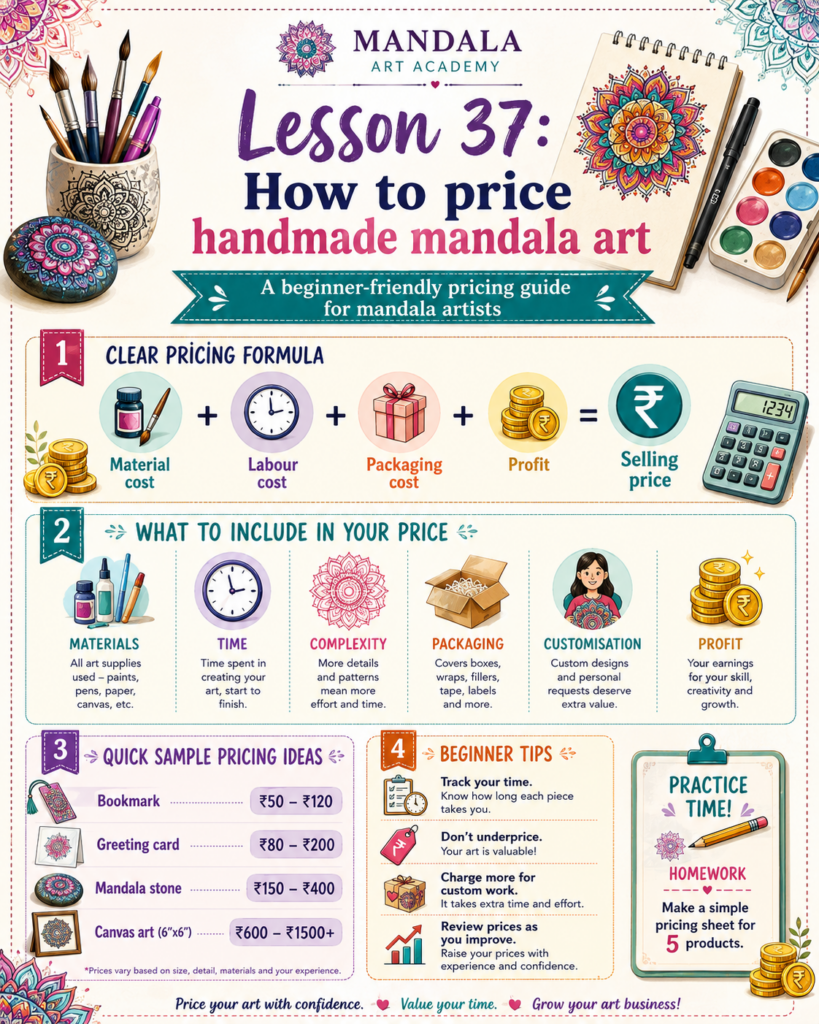
Simple pricing formula
Use this beginner-friendly formula:
Material cost + labour cost + packaging cost + profit = selling price
For example:
Material cost: ₹30
Labour cost: ₹80
Packaging cost: ₹15
Profit: ₹25
Selling price: ₹150
This simple formula helps you avoid underpricing.
Step 1: Calculate material cost
Start by calculating how much material you used for one product.
For a mandala bookmark, material cost may include:
Cardstock
Pen ink
Colour pencils or brush pen usage
Ribbon or tassel
Lamination sheet
Small embellishments
Packaging cover
For a canvas mandala, material cost may include:
Canvas board
Acrylic paint
Paint pens
Brush usage
Dotting tools
Varnish
Frame if included
You do not need to calculate every tiny drop perfectly, but you should have a reasonable estimate.
Step 2: Calculate your time
Your time has value. Even if you are a beginner, your time should be included in the price.
Write down how long each product takes.
Example:
Mandala bookmark: 30 to 45 minutes
Greeting card: 45 to 75 minutes
Mandala stone: 45 to 60 minutes
Small framed mandala: 1 to 2 hours
Canvas mandala: 2 to 5 hours
Large wall art: several hours or days
Then decide a basic hourly value for your work. As a beginner, you can start modestly and increase slowly as your finishing, demand and confidence improve.
Step 3: Add labour cost
Labour cost means payment for your time and effort.
Example:
If you decide your time value is ₹100 per hour and one bookmark takes 30 minutes, labour cost is around ₹50.
If a greeting card takes one hour, labour cost is ₹100.
If a canvas mandala takes three hours, labour cost is ₹300.
This helps you avoid selling your time for free.
Step 4: Add packaging cost
Packaging is part of the product experience. Even a small handmade item needs safe and neat packing.
Packaging cost may include:
Tissue paper
Butter paper
Thank-you card
Envelope
Ribbon
Bubble wrap
Cardboard backing
Courier cover
Sticker
Box
If packaging costs ₹10 or ₹20, include it in the price. Do not ignore small costs because they add up over many orders.
Step 5: Add profit
Profit is important because it helps your small business grow. Profit allows you to buy better materials, create samples, improve packaging and continue making products.
Profit does not have to be very high in the beginning. But every product should have some profit.
For small products, profit may be ₹20 to ₹50.
For medium products, profit may be ₹100 to ₹300.
For large artworks, profit may be higher depending on size and complexity.
Without profit, you are only recovering cost, not building a business.
Step 6: Price based on size
Size affects price because larger artwork uses more material and takes more time.
For example:
Small bookmark: lower price
Greeting card: medium price
A5 mandala art: higher than a card
A4 framed mandala: higher
Canvas mandala: higher
A3 wall art: premium price
Always mention size clearly in your product description so customers understand the price.
Step 7: Price based on complexity
Not all mandalas take the same effort. A simple black-and-white mandala should not be priced the same as a detailed layered colour mandala with metallic highlights.
Complexity depends on:
Number of layers
Number of colours
Amount of detail
Use of metallic or glitter work
Custom name or message
Time taken
Framing or finishing
Surface type
A detailed custom mandala should cost more than a simple ready design.
Step 8: Price ready products and custom orders differently
Ready products are easier to price because they are already made. Custom orders need more communication, planning and changes.
For custom orders, charge slightly higher because you are giving personalised effort.
For example:
Ready mandala bookmark: ₹80
Custom name mandala bookmark: ₹120
Ready greeting card: ₹150
Custom greeting card with name/message: ₹200
Ready A4 mandala art: ₹600
Custom A4 mandala with colour theme/name: ₹800 or more
Customisation has value.
Step 9: Consider festive and bulk orders
During festivals, customers may order return gifts, greeting cards, bookmarks, mandala stones or gift tags in bulk.
For bulk orders, you can offer a small discount, but only after calculating your cost properly.
Example:
Single bookmark: ₹80
Set of 5 bookmarks: ₹375
Set of 10 bookmarks: ₹700
Do not reduce the price so much that you lose money. Bulk orders still take time and packing effort.
Step 10: Compare, but do not copy prices
It is okay to check what other handmade artists are charging, but do not blindly copy their prices.
Their material quality, experience, finishing, packaging, audience and location may be different from yours.
Use market prices only as a reference. Your price should be based on your cost, time and quality.
Step 11: Create price ranges
Price ranges help customers choose based on budget.
You can create:
Budget products
Mid-range products
Premium products
Example:
Budget: bookmarks, gift tags, small stones
Mid-range: greeting cards, mini frames, custom name art
Premium: canvas mandalas, framed wall art, large custom mandalas
This way, customers with different budgets can buy from you.
Step 12: Do not underprice because you are a beginner
Many beginners say, “I am new, so I should charge very low.” But if your product is neat, finished and useful, it deserves a fair price.
You can start with beginner-friendly prices, but do not price so low that you feel tired or unhappy after every order.
Your confidence will grow when you respect your own effort.
Sample pricing guide for beginners
These are only example ranges. You can adjust based on your materials, time and finishing.
Mandala bookmark: ₹70 to ₹150
Mandala greeting card: ₹120 to ₹250
Mandala gift tag set: ₹100 to ₹250
Mandala stone: ₹150 to ₹400
Mini framed mandala: ₹300 to ₹700
A5 mandala artwork: ₹300 to ₹800
A4 mandala artwork: ₹600 to ₹1,500
Small canvas mandala: ₹500 to ₹1,500
Large wall art: ₹1,500 and above
Start with realistic prices and increase as your work improves.
Example pricing calculation: Mandala bookmark
Material cost: ₹20
Ribbon and finishing: ₹10
Packaging: ₹10
Labour: ₹50
Profit: ₹20
Selling price: ₹110
You can round it to ₹99, ₹110 or ₹120 depending on your customer base.
Example pricing calculation: Mandala greeting card
Cardstock and paper: ₹30
Pens and colours: ₹20
Embellishments: ₹15
Envelope and packing: ₹15
Labour: ₹100
Profit: ₹40
Selling price: ₹220
You can price it at ₹199 or ₹225 depending on the design.
Example pricing calculation: Mandala stone
Stone or base: ₹30
Paint usage: ₹20
Varnish: ₹10
Packaging: ₹20
Labour: ₹100
Profit: ₹50
Selling price: ₹230
You can price it at ₹229 or ₹250.
Example pricing calculation: Canvas mandala
Canvas board: ₹100
Paint and pens: ₹80
Varnish: ₹30
Packaging: ₹50
Labour for 3 hours: ₹300
Profit: ₹200
Selling price: ₹760
You can price it at ₹750, ₹799 or ₹850 depending on finishing and demand.
How to explain your price to customers
Sometimes customers may ask why handmade products cost more. Answer politely and confidently.
You can say:
“This is a handmade piece created with detailed mandala work, quality materials and careful finishing. The price includes materials, time, design work and packaging.”
Do not sound defensive. Handmade work has value.
When to increase your prices
You can increase prices when:
Your finishing improves
Your designs become more detailed
You start getting repeat orders
Your material cost increases
You add better packaging
You offer customisation
Your waiting time increases
Your work becomes more professional
Price growth should happen slowly and confidently.
When to offer discounts
Discounts can be useful, but do not offer them all the time.
Good times to offer discounts:
Festival sale
First launch offer
Bulk order
Repeat customer
Clearance of ready stock
Combo sets
Avoid giving discounts on every custom order because it reduces your value.
Common pricing mistakes to avoid
Do not charge only for materials.
Do not forget your time.
Do not ignore packaging cost.
Do not include free delivery without calculating courier cost.
Do not copy another seller’s price blindly.
Do not reduce price immediately when someone asks.
Do not feel guilty for earning profit.
Do not accept complex custom work at a simple product price.
Professional tips
Keep a pricing notebook or spreadsheet.
Record material cost for each product.
Track time taken for different designs.
Create fixed prices for standard products.
Charge extra for names, custom colours and urgent orders.
Take advance payment for custom orders.
Mention dispatch time clearly.
Review your prices every few months.
Beginner pricing exercise
Choose one mandala product you want to sell. Write down:
Material cost
Time taken
Packaging cost
Profit amount
Final selling price
Then check whether the price feels fair for both you and the customer.
Creative challenge
Create a price list for five mandala products.
Include:
Product name
Size
Starting price
Customisation charge
Dispatch time
This will help you feel more confident when customers ask for prices.
Homework
Prepare your first mandala pricing sheet.
Write prices for:
Mandala bookmark
Mandala greeting card
Mandala stone
Mini framed mandala
Canvas mandala
Custom name mandala
Keep the sheet simple and update it as you learn more.
Key takeaways
Handmade mandala art should be priced based on material, time, packaging and profit.
Your time has value, even as a beginner.
Custom orders should cost more than ready products.
Bigger and more detailed artwork should be priced higher.
Do not underprice only because you are new.
Clear pricing builds confidence and professionalism.
Lesson summary
In this lesson, you learned how to price handmade mandala art using a simple formula: material cost, labour cost, packaging cost and profit. You also learned how size, complexity, customisation, finishing, bulk orders and presentation affect pricing.
Pricing is an important step in turning your mandala hobby into a small home-based business. When you price fairly, you respect your creativity and make your handmade journey more sustainable.
Previous lesson: Lesson 36: How to sell mandala artwork from home
Next lesson: Lesson 38: How to sell mandala digital downloads
Support the free Mandala Art Academy
Learning mandala art with us? The Mandala Art Academy is completely free, and every contribution helps us create more step-by-step lessons, practice guides and original tutorial images.
Even a small contribution helps us continue the next lesson.
For supporters in India
Scan the QR code below or use the UPI ID to contribute any amount you are comfortable with.

UPI ID: pallavi.rags-1@okhdfcbank
Pay securely through Razorpay
Prefer to pay by card or another supported online payment method? Use our secure Razorpay page below. Indian and international cards are accepted.
Support Mandala Art Academy and help create the next free lesson
Your support is entirely optional. Every Mandala Art Academy lesson will remain free for everyone.
Thank you for learning with us and helping us create the next lesson. ❤️