Learn the most common beginner mistakes in mandala art and discover practical tips to improve symmetry, balance, line quality and drawing confidence.
Course: STM Creator Academy – Mandala Art Master Course
Module: 1 – Getting Started
Lesson: 5 of 40
Estimated Reading Time: 15–20 minutes
Skill Level: Beginner
Welcome back!
You’ve now learned what mandala art is, gathered the right supplies, created your first mandala grid and understood the importance of circles, symmetry and balance.
At this stage, many beginners become excited and immediately start drawing detailed patterns. However, almost everyone makes a few common mistakes during their first few mandalas.
The good news is that these mistakes are completely normal. Even experienced mandala artists made them when they first started.
In this lesson, you’ll learn how to identify these mistakes early and develop good drawing habits that will make every future mandala cleaner, more balanced and more enjoyable to create.
What you’ll learn
By the end of this lesson, you’ll be able to:
- Recognise the most common beginner mistakes.
- Improve line quality and accuracy.
- Create cleaner, more balanced mandalas.
- Build confidence without striving for perfection.
- Develop good artistic habits from the beginning.
Mistake 1: Skipping the grid
Many beginners feel excited to start drawing immediately and skip creating a proper grid.
Without a grid, petals become uneven, spacing changes from one section to another and the overall mandala loses its balance.
Always spend a few extra minutes creating your guide circles and dividing the design into equal sections. Those few minutes save a lot of corrections later.
Mistake 2: Pressing too hard with the pencil
One of the biggest beginner mistakes is drawing dark pencil lines.
Heavy guidelines become difficult to erase and often remain visible after inking.
Instead, use very light pencil strokes.
Your pencil should guide your drawing, not become part of the finished artwork.
Mistake 3: Trying to make everything perfect
Many beginners erase every tiny mistake.
This interrupts creativity and often causes frustration.
Remember that handmade artwork naturally contains small variations.
Most people will never notice the tiny imperfections that you see.
Progress is always more valuable than perfection.
Mistake 4: Drawing too quickly
Mandala art is not a race.
Rushing usually results in uneven petals, shaky lines and inconsistent spacing.
Slow, controlled movements produce much cleaner artwork.
Enjoy the process rather than focusing only on the finished result.
Mistake 5: Using too many different patterns
After learning a few shapes, beginners often try to include every pattern in one mandala.
The result can look crowded and confusing.
Instead, choose two or three simple patterns and repeat them consistently.
Beautiful mandalas are built through repetition, not complexity.
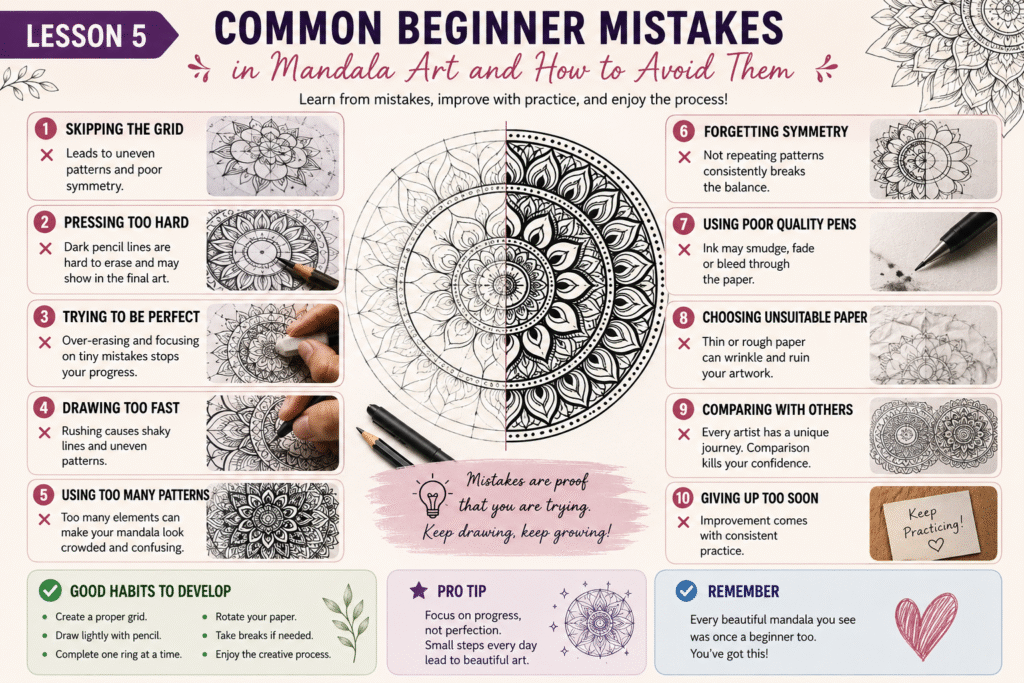
Mistake 6: Forgetting symmetry
Sometimes beginners become so focused on drawing that they forget to repeat the same pattern around the circle.
Always complete one ring at a time.
Draw one shape.
Then repeat it in every section before moving to the next pattern.
This keeps your artwork balanced.
Mistake 7: Using poor-quality pens
Low-quality pens may:
- Smudge.
- Bleed through paper.
- Produce uneven ink flow.
- Fade over time.
Investing in a good fineliner makes drawing much more enjoyable.
You don’t need expensive supplies, but reliable tools make a noticeable difference.
Mistake 8: Choosing unsuitable paper
Very thin paper wrinkles easily and allows ink to bleed through.
Choose smooth drawing paper or sketchbook paper with enough thickness for fineliners.
The right paper helps your artwork look cleaner and more professional.
Mistake 9: Comparing yourself with experienced artists
Social media often shows artwork created by artists with years of practice.
Comparing your first mandala with someone else’s hundredth is unfair.
Every beautiful mandala artist started as a beginner.
Focus on becoming slightly better with every drawing.
Mistake 10: Giving up after one drawing
The first mandala rarely becomes your favourite.
Neither does the second.
Every drawing improves your hand control, pattern recognition and confidence.
Consistency matters far more than natural talent.
Good habits every beginner should develop
Try to make these habits part of every drawing session:
- Begin with a clean workspace.
- Draw light pencil guidelines.
- Rotate the paper instead of twisting your wrist.
- Complete one ring before starting another.
- Take short breaks to avoid hand fatigue.
- Enjoy the creative process.
These small habits produce big improvements over time.
Practice exercise
Using your grid from Lesson 3:
Draw a small practice mandala using only:
- Teardrop petals
- Small circles
- Curved lines
As you draw, pay attention to avoiding the mistakes discussed in this lesson.
Don’t erase every tiny imperfection.
Simply complete the artwork.
Pro tips from STM Creator Academy
- Finished artwork teaches more than unfinished perfection.
- Every completed mandala builds confidence.
- Simple designs often look more elegant than complicated ones.
- Practice regularly, even if it’s only for 15 minutes.
- Keep your early artwork so you can see your improvement over time.
Homework
Create one complete beginner mandala using everything you’ve learned so far.
Focus on:
- Accurate grid
- Symmetry
- Balanced spacing
- Clean lines
- Repetition
Take a photo and share it with STM Creator Academy.
📧 Email: pallavi.rags@gmail.com
📸 Instagram: @jewellerymakingmaterials
🏷 Hashtag: #STMCreatorAcademy
Key takeaways
- Every beginner makes mistakes.
- Grids are essential for symmetry.
- Draw lightly with pencil.
- Don’t chase perfection.
- Repeat patterns consistently.
- Practice regularly to improve naturally.
Lesson summary
Mistakes are not signs of failure. They are part of every artist’s learning journey.
By recognising these common beginner mistakes early, you’ll build stronger drawing habits that will help every future mandala become cleaner, more balanced and more enjoyable to create.
Congratulations! You’ve now completed Module 1 – Getting Started.
In the next lesson, you’ll begin Module 2: Basic Mandala Patterns, where you’ll learn how to draw your very first beautiful mandala petals.
Previous lesson
← Lesson 4: Understanding circles, symmetry and balance in mandala art
🏠 Back to Mandala Art Master Course
Next lesson
➡ Lesson 6: Drawing basic mandala petals step by step
Support the free Mandala Art Academy
Learning mandala art with us? The Mandala Art Academy is completely free, and every contribution helps us create more step-by-step lessons, practice guides and original tutorial images.
Even a small contribution helps us continue the next lesson.
For supporters in India
Scan the QR code below or use the UPI ID to contribute any amount you are comfortable with.

UPI ID: pallavi.rags-1@okhdfcbank
Pay securely through Razorpay
Prefer to pay by card or another supported online payment method? Use our secure Razorpay page below. Indian and international cards are accepted.
Support Mandala Art Academy and help create the next free lesson
Your support is entirely optional. Every Mandala Art Academy lesson will remain free for everyone.
Thank you for learning with us and helping us create the next lesson. ❤️