Learn why circles, symmetry and balance are essential in mandala art. This beginner-friendly lesson explains the core principles behind beautiful mandala designs.
Course: STM Creator Academy – Mandala Art Master Course
Module: 1 – Foundations
Lesson: 4 of 40
Estimated Reading Time: 15–20 minutes
Skill Level: Beginner
Welcome back!
You’ve now learned what mandala art is, gathered the essential supplies and created your very first mandala grid. Congratulations! You’re building the same foundation used by artists around the world.
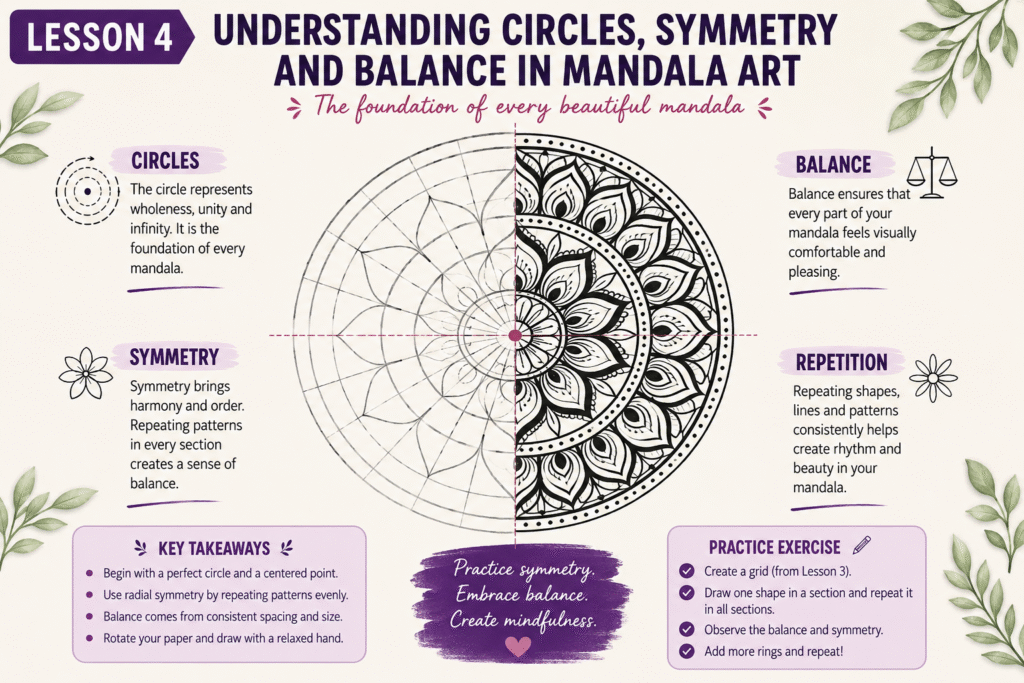
Before we begin drawing beautiful petals, floral motifs and intricate decorative elements, it’s important to understand three simple principles that make every mandala visually appealing: circles, symmetry and balance.
Many beginners believe that artistic talent is the secret to drawing beautiful mandalas. In reality, the secret lies in understanding these three concepts. Once you learn them, creating elegant mandala designs becomes much easier.
In this lesson, you’ll discover why mandalas always begin with circles, how symmetry creates harmony, and how balance transforms a simple drawing into a stunning work of art.
What you’ll learn
By the end of this lesson, you will be able to:
- Understand why circles are the foundation of mandala art.
- Recognize different types of symmetry.
- Create balanced designs with confidence.
- Avoid common symmetry mistakes.
- Prepare for drawing your first decorative patterns.
Why is the circle so important in mandala art?
Almost every mandala begins with a circle.
But why?
A circle has no beginning and no end. It represents completeness, unity and continuity. Across many cultures, circles have symbolized harmony, nature and the cycle of life.
From a drawing perspective, the circle is equally important because every point on its edge is the same distance from the centre. This natural balance makes it the perfect foundation for repeating patterns evenly.
When you draw within a circle, every design grows outward in a controlled and organised way.
The centre is the heart of every mandala
Every mandala starts from a single point.
This centre point acts as the anchor for the entire artwork.
Every circle you draw, every petal you create and every border you add should relate back to this centre.
If your centre shifts, the entire design can appear uneven.
That’s why professional mandala artists spend time creating accurate grids before adding decorative elements.
What is symmetry?
Symmetry simply means that different parts of a design match each other.
Imagine folding a piece of paper exactly in half.
If both sides look identical, the design is symmetrical.
Mandalas rely heavily on symmetry because repeating the same shapes around a central point creates a sense of order and beauty.
Symmetry doesn’t limit creativity. Instead, it gives your creativity a structure.
Types of symmetry used in mandala art
The most common type is radial symmetry.
In radial symmetry, one pattern is repeated around the centre of the circle.
For example, if you draw one petal in one section of your grid, you repeat the same petal in every other section.
This repetition creates the beautiful, balanced appearance that makes mandalas so recognizable.
Some artists also use mirror symmetry, where one side reflects the other, but beginners should focus on radial symmetry first.
Understanding balance
Balance is different from symmetry.
A design can be symmetrical but still feel heavy on one side if one area contains much larger or darker patterns than another.
Good balance means that every section of your mandala feels visually comfortable.
For example, if you draw large petals in one ring, consider using similarly sized patterns around the entire circle.
Likewise, if one section contains bold outlines, repeat those bold outlines consistently.
Balance allows the viewer’s eyes to move naturally around the artwork.
Why repetition makes mandalas beautiful
One of the easiest ways to improve your mandalas is through repetition.
Instead of inventing a different shape for every section, choose one pattern and repeat it evenly.
This creates rhythm.
Just as music repeats notes to create harmony, mandalas repeat shapes to create visual harmony.
Even simple patterns become elegant when repeated consistently.
Learning to rotate your paper
Many beginners twist their wrist into uncomfortable positions while drawing.
A much easier technique is to rotate the paper instead.
Keep your hand relaxed.
Turn the paper so every section is comfortable to draw.
Professional artists do this constantly because it helps maintain consistent lines and shapes.
Common beginner mistakes
Many beginners:
- Draw different-sized petals in each section.
- Forget to repeat patterns consistently.
- Press too hard with the pencil.
- Ignore the grid after creating it.
- Rush through the drawing.
Don’t worry if your first few mandalas aren’t perfectly symmetrical.
Every completed drawing teaches your hand to become more accurate.
Practice exercise
Take the grid you created in Lesson 3.
Without adding decorative details:
- Draw one simple teardrop shape in one section.
- Repeat it in all remaining sections.
- Draw one small circle in the next ring.
- Repeat it around the entire mandala.
- Add one curved line in another ring.
- Repeat it evenly.
Notice how repeating simple shapes immediately creates a beautiful design.
Pro tips from STM Creator Academy
- Always begin from the centre and work outward.
- Rotate the paper rather than twisting your wrist.
- Repeat one shape before introducing another.
- Keep spacing consistent.
- Use light pencil guidelines until the design is complete.
- Don’t compare your work with artists who have years of experience.
Real-world inspiration
Symmetry appears everywhere around us.
You can find mandala-inspired patterns in:
- Flowers
- Sunflowers
- Snowflakes
- Spider webs
- Rangoli designs
- Temple ceilings
- Stained glass windows
- Traditional Indian art
- Decorative floor tiles
Observing these natural and artistic patterns will improve your understanding of balance and repetition.
Homework
Using the grid from Lesson 3, create a simple practice mandala using only:
- Circles
- Teardrop shapes
- Curved lines
Do not worry about creating a masterpiece.
Your goal is simply to practice symmetry and repetition.
Take a photograph of your finished practice page and share it with STM Creator Academy.
📧 Email: pallavi.rags@gmail.com
📸 Instagram: @jewellerymakingmaterials
🏷 Hashtag: #STMCreatorAcademy
Key takeaways
- Every mandala begins with a balanced circle.
- The centre point guides the entire artwork.
- Radial symmetry is the foundation of mandala design.
- Repetition creates harmony and beauty.
- Balance helps every section feel visually connected.
- Practice is more important than perfection.
Lesson summary
Today you learned the three principles that make every mandala successful: circles, symmetry and balance.
Understanding these concepts will make every future lesson easier because you’ll know why each pattern is placed where it is.
In the next lesson, you’ll finally begin creating your first decorative element by learning how to draw beautiful mandala petals step by step.
Previous lesson
← Lesson 3: How to draw your first perfect mandala grid step by step
🏠 Back to Mandala Art Master Course
Next lesson
➡ Lesson 5: Common beginner mistakes and how to avoid them
Support the free Mandala Art Academy
Learning mandala art with us? The Mandala Art Academy is completely free, and every contribution helps us create more step-by-step lessons, practice guides and original tutorial images.
Even a small contribution helps us continue the next lesson.
For supporters in India
Scan the QR code below or use the UPI ID to contribute any amount you are comfortable with.

UPI ID: pallavi.rags-1@okhdfcbank
Pay securely through Razorpay
Prefer to pay by card or another supported online payment method? Use our secure Razorpay page below. Indian and international cards are accepted.
Support Mandala Art Academy and help create the next free lesson
Your support is entirely optional. Every Mandala Art Academy lesson will remain free for everyone.
Thank you for learning with us and helping us create the next lesson. ❤️