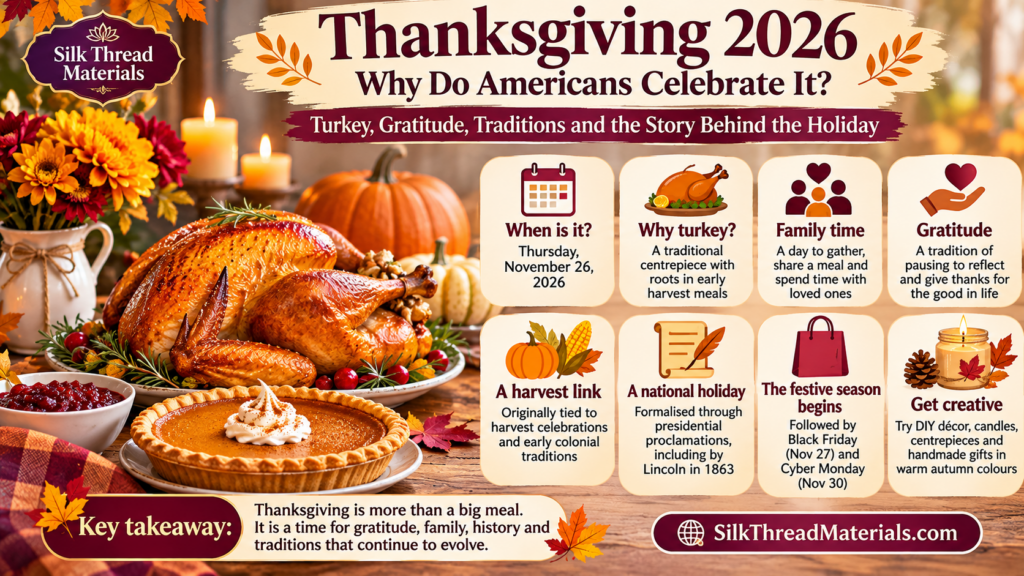
Thanksgiving will be celebrated in the United States on Thursday, November 26, 2026. Observed on the fourth Thursday of November, it is one of the country’s major federal holidays and is traditionally associated with family gatherings, large meals, gratitude and the beginning of the year-end festive season.
For people outside the United States, Thanksgiving can sometimes look like a holiday built around turkey, pumpkin pie and shopping.
But the modern celebration carries several layers.
It is a family holiday, a gratitude tradition, a harvest-season observance, a complicated part of American history and increasingly the unofficial gateway to Christmas shopping through Black Friday and Cyber Monday.
So why do Americans celebrate Thanksgiving, why is turkey so important, and why does the holiday always fall on a Thursday?
When is Thanksgiving 2026?
Thanksgiving Day falls on Thursday, November 26, 2026.
In the United States, Thanksgiving is observed on the fourth Thursday of November each year. It is a federal holiday, meaning many government offices close, while schools and businesses may also close or operate differently.
The day after Thanksgiving is Black Friday, which falls on November 27 in 2026.
That makes Thanksgiving the point where the American festive calendar begins accelerating rapidly toward Christmas.
Why do Americans celebrate Thanksgiving?
At its simplest, Thanksgiving is a day centred on giving thanks.
Families and friends often gather for a meal and reflect on the people, experiences and opportunities they appreciate.
But the history of Thanksgiving is more complicated than the simplified schoolbook image of one peaceful meal between Pilgrims and Native Americans.
The Library of Congress notes that thanksgiving ceremonies existed in North America in different forms before the famous 1621 Plymouth celebration. Native communities had longstanding traditions of giving thanks for nature’s gifts, and other European settlements also held thanksgiving observances before Plymouth.
That history is worth understanding because it shows that Thanksgiving did not begin from one single event.
It developed over centuries.
What happened at the 1621 Thanksgiving?
The 1621 Plymouth harvest celebration is the event most commonly associated with the origins of today’s Thanksgiving traditions.
English colonists at Plymouth and members of the Wampanoag community participated in a three-day harvest gathering.
According to Library of Congress material, foods included wild turkey, duck, geese, venison, seafood, corn, vegetables and dried fruits.
The event later became central to popular American storytelling about Thanksgiving, although modern historians also emphasise the much broader and more difficult history of relations between European settlers and Native peoples.
Understanding both sides makes the holiday more meaningful.
Celebrating gratitude does not require ignoring history.
Did Thanksgiving immediately become an annual American holiday?
No.
The 1621 gathering did not immediately create the modern annual Thanksgiving holiday.
Different colonies and states observed days of thanksgiving at different times.
George Washington proclaimed a national day of thanksgiving in 1789, but Thanksgiving still did not become a consistent annual national tradition at that stage.
During the American Civil War, President Abraham Lincoln proclaimed a national Thanksgiving observance in 1863 after years of advocacy by writer and editor Sarah Josepha Hale.
That helped establish Thanksgiving much more firmly as a national tradition.
Why is Thanksgiving always on a Thursday?
The modern American holiday is officially observed on the fourth Thursday of November.
Thursday became deeply associated with Thanksgiving through historical presidential proclamations and later federal practice.
That creates something many Americans love almost as much as the dinner itself: a long weekend.
For people who can take Friday off, Thanksgiving can become a four-day break stretching from Thursday through Sunday.
That is one reason the holiday is associated with some of the heaviest family travel of the year.
Why is turkey the traditional Thanksgiving food?
Turkey has become the symbol of the Thanksgiving table.
It makes practical sense for a large family meal because one large bird can feed several people, and wild turkey was historically available in North America.
The Library of Congress notes that wild turkey was among the foods associated with the 1621 Plymouth harvest gathering, although the menu was much broader than the modern Thanksgiving dinner.
Over time, roast turkey became increasingly central to Thanksgiving menus.
Today, a Thanksgiving table may feel incomplete to many families without it.
What else do Americans eat on Thanksgiving?
Modern Thanksgiving meals vary enormously between households, regions and cultural backgrounds.
Classic dishes commonly include roast turkey, stuffing or dressing, mashed potatoes, gravy, vegetables, cranberry sauce and pumpkin pie.
But the United States is culturally diverse, so families often incorporate their own food traditions.
An Indian-American family might include biryani or paneer alongside turkey.
A Mexican-American family may bring regional dishes to the table.
Other households may skip turkey completely.
That is part of what makes Thanksgiving interesting.
The meal evolves with the family celebrating it.
Why is pumpkin pie associated with Thanksgiving?
Pumpkins are strongly connected with the North American autumn harvest.
By late November, pumpkin-spiced foods, pumpkin decorations and pumpkin pie have already become part of the seasonal atmosphere.
Pumpkin pie eventually became one of the most recognisable Thanksgiving desserts.
The flavours also fit the season: cinnamon, nutmeg, ginger and other warm spices are closely associated with autumn and winter celebrations.
For many people, the smell of pumpkin pie is almost as strongly connected with Thanksgiving as roast turkey.
Why is cranberry sauce served with turkey?
Cranberries are native to North America and have long been associated with regional food traditions.
Their tart flavour contrasts with rich foods such as turkey, gravy and stuffing.
That combination helped cranberry sauce become a familiar part of Thanksgiving meals.
Food traditions often survive because they are not merely symbolic.
Sometimes they simply taste good together.
Why is gratitude so central to Thanksgiving?
The most enduring Thanksgiving tradition may be the simplest one.
Giving thanks.
Some families say a prayer before the meal.
Others take turns sharing something they are grateful for.
Some write gratitude notes.
Others simply use the occasion to reconnect with people they may not see frequently.
The ritual does not have to be formal.
The value lies in intentionally recognising things that everyday life makes easy to overlook.
Can gratitude actually be useful?
Gratitude should not be presented as a magical solution to every problem.
Someone going through financial difficulty, grief or illness should not be told that they only need to “be grateful.”
But deliberately noticing positive experiences, supportive relationships and small improvements can help people pay attention to parts of life that may otherwise disappear beneath routine.
Thanksgiving provides a natural cultural moment for that reflection.
The important idea is not pretending everything is perfect.
It is recognising what remains valuable even when life is imperfect.
Why do families travel so much for Thanksgiving?
For many Americans, Thanksgiving is primarily a family holiday rather than a religious festival.
Adult children may return to their parents’ homes.
Siblings travel across states.
Grandparents host large meals.
College students go home for the break.
That means Thanksgiving often becomes one of the rare times in the year when extended families deliberately gather around the same table.
The travel may be exhausting.
The meal may take hours to prepare.
Family conversations may occasionally become complicated.
Yet people continue doing it because rituals create continuity.
The same recipe, table, serving dish or family joke can become part of a tradition repeated for decades.
What is Friendsgiving?
Not everyone can spend Thanksgiving with relatives.
That helped popularise another modern tradition known as Friendsgiving.
Friends gather for a Thanksgiving-style meal, often before or around the official holiday.
Each person may bring one dish, turning the event into a potluck.
Friendsgiving is particularly popular among students, young professionals and people living far from their families.
It reflects an important idea:
Family traditions can also be created with the communities we choose.
Why are Thanksgiving decorations usually orange, brown and gold?
Thanksgiving visual style is strongly influenced by autumn.
Think pumpkins, dried leaves, wheat, pinecones, wooden tables, candles and warm colours.
Orange represents pumpkins and autumn leaves.
Brown connects with wood and earth.
Gold and mustard shades reflect harvest imagery.
Deep red adds warmth.
That is why Thanksgiving décor looks very different from the red, green and sparkling white associated with Christmas only a few weeks later.
For craft lovers, this creates an excellent opportunity for handmade autumn décor.
What Thanksgiving crafts can families make at home?
Thanksgiving is particularly suitable for simple family crafts because much of its imagery comes directly from autumn.
Children can create gratitude cards, paper leaves or handmade table decorations.
Adults can make candle centrepieces, napkin decorations, wreaths, name cards or small handmade gifts for guests.
A simple gratitude jar can also become a family tradition.
Each person writes something they are thankful for on a small piece of paper and adds it to the jar.
The notes can then be read together during dinner.
Unlike expensive décor, these handmade traditions often become the things families remember most.
How can candle makers use Thanksgiving for inspiration?
Thanksgiving is a beautiful theme for candle makers.
Warm colour palettes such as cream, pumpkin orange, cinnamon brown, burgundy and muted gold work naturally with the season.
Fragrance inspiration can include vanilla, cinnamon, apple, orange, coffee, woody notes or other candle-safe autumn fragrance oils.
A handmade candle can also become a thoughtful host gift.
If you are creating candles at home, however, always use candle-safe fragrance materials and follow proper wax, wick and fragrance-load guidance.
Festive aesthetics should never replace candle safety.
How can jewellery and craft lovers use Thanksgiving colours?
Although jewellery is not central to Thanksgiving tradition, autumn colour palettes are excellent for handmade accessories.
Rust, maroon, mustard, chocolate brown, antique gold, cream and forest green can create warm seasonal combinations.
Beads, pearls and antique-gold components can also be used for simple handmade gifts.
This is where global festivals can inspire makers even if they do not personally celebrate every tradition.
Creativity often begins by observing colour, texture and symbolism.
Why does Black Friday come immediately after Thanksgiving?
Black Friday falls on the day after Thanksgiving.
In 2026, it will be Friday, November 27.
For retailers, Thanksgiving weekend marks one of the most important shopping periods of the year.
Many people begin purchasing Christmas gifts during this period.
Black Friday is then followed by Cyber Monday, which falls on November 30 in 2026.
This creates a dramatic transition.
One day focuses on gratitude for what people already have.
The next encourages them to buy more.
There is a little irony there.
Does Thanksgiving have a difficult side to its history?
Yes, and responsible explanations of Thanksgiving should acknowledge it.
For many Native Americans, the popular Thanksgiving story can oversimplify or romanticise a much more painful history of colonisation, displacement and violence.
The Library of Congress itself notes that Native communities had thanksgiving traditions long before European arrival and that the way the 1621 celebration has been represented has changed significantly over time.
Teaching Thanksgiving therefore does not have to mean choosing between celebration and historical awareness.
Families can express gratitude while also learning about Native American history and recognising perspectives that were frequently excluded from older versions of the story.
What can Indian families learn from Thanksgiving?
You do not have to live in the United States or celebrate Thanksgiving formally to appreciate its central idea.
Indian festivals already contain many similar themes.
Families gather.
Food is prepared.
Homes are decorated.
Gratitude is expressed.
Older and younger generations spend time together.
The cultural stories are different, but the human behaviour is surprisingly familiar.
That is one reason learning about festivals from other countries can be so interesting.
The traditions reveal both differences and similarities.
A simple Thanksgiving activity anyone can try
Before dinner on November 26, ask everyone at the table to answer one question:
“What happened this year that I do not want to take for granted?”
It could be something big.
A new job.
Recovery from an illness.
A new family member.
Or something ordinary.
A peaceful home.
A friend who listens.
Being able to learn something new.
The answer does not need to impress anyone.
Gratitude becomes meaningful when it is specific.
The deeper meaning of Thanksgiving
Thanksgiving is often photographed as an enormous table filled with food.
But perhaps the table itself is not the most important part.
The people around it are.
A meal disappears in an evening.
Decorations are packed away.
The shopping season begins almost immediately.
But the annual decision to gather, remember and give thanks creates something more lasting.
It creates family memory.
That is why Thanksgiving continues to matter to millions of Americans.
Not because every family follows exactly the same tradition.
Not because the holiday’s history is simple.
And certainly not because everyone likes cranberry sauce.
It matters because once every year, people deliberately stop and ask:
What do I already have that is worth appreciating?
That question can travel far beyond the United States.