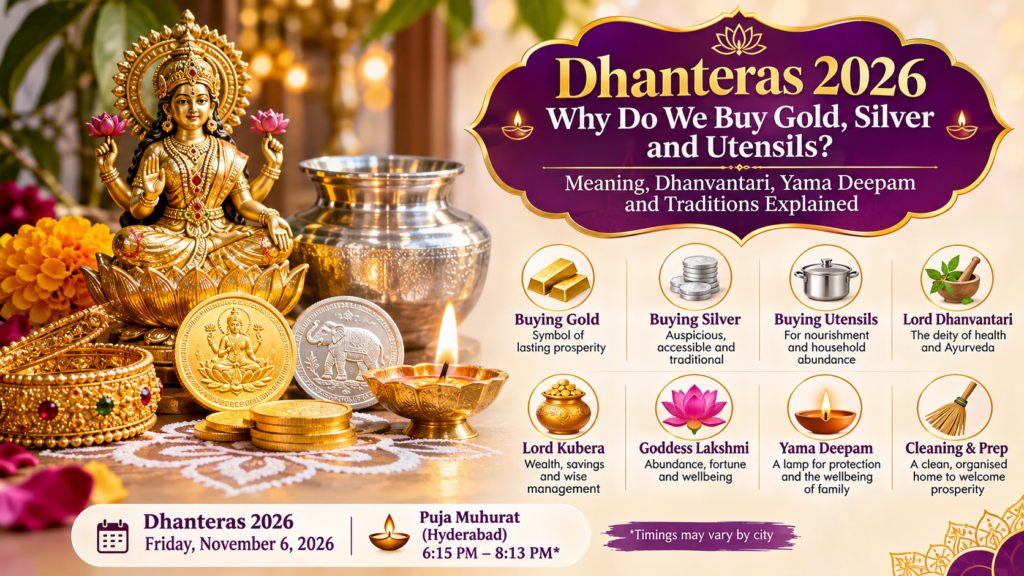
Dhanteras will be celebrated on Friday, November 6, 2026, marking the traditional beginning of the Diwali festive period for many families across India. Shops fill with gold and silver jewellery, steel and brass utensils, coins, lamps, home products and gifts as people bring something new into their homes. Yet Dhanteras is not simply an annual shopping festival.
Behind the familiar custom of buying gold lies a much broader story involving prosperity, Goddess Lakshmi, Lord Kubera, Lord Dhanvantari, health, household wellbeing and the unusual tradition of lighting a lamp for Yama.
Why is buying metal considered auspicious? Why are utensils so popular? Why is Dhanvantari remembered on Dhanteras? And why do some families place a diya outside their home facing south?
Understanding these traditions makes the first day of Diwali much more meaningful than simply asking, “What should we buy today?”
When is Dhanteras in 2026?
Dhanteras falls on Friday, November 6, 2026.
The festival is observed on Trayodashi, the thirteenth lunar day of Krishna Paksha in the Kartika period followed by many North Indian calendars.
The exact Lakshmi and Kubera puja timings depend on location. For Hyderabad, the commonly calculated Dhanteras puja period is approximately 6:15 PM to 8:13 PM. Families following a specific panchang should always check their own city because sunset, Pradosh Kaal and related timings vary geographically.
Dhanteras is followed by the remaining Diwali observances, with Lakshmi Puja and the main Diwali celebration falling on November 8 in 2026.
What does the word Dhanteras actually mean?
The name itself helps explain the festival.
“Dhan” commonly refers to wealth or prosperity, while “Teras” comes from Trayodashi, meaning the thirteenth lunar day.
That may make Dhanteras sound like a festival concerned only with money.
Traditionally, however, the idea of wealth is much broader.
A prosperous household needs money, but it also needs health, food, tools, knowledge, relationships, stability and the ability to sustain itself.
That wider idea becomes especially interesting when we look at the two major associations of Dhanteras: prosperity through Lakshmi and Kubera, and health through Dhanvantari.
Why do people buy gold on Dhanteras?
Buying gold on Dhanteras is one of the most visible modern traditions.
Gold has represented stored wealth, security, auspiciousness and status in Indian households for generations. Unlike many decorative purchases, jewellery historically also functioned as an asset that families could retain, gift or pass between generations.
Purchasing gold on a day associated with prosperity therefore became symbolically powerful.
For some families, the purchase may be a major piece of jewellery.
For others, it may simply be a tiny gold coin.
The value of the ritual does not have to depend on how much money is spent.
The underlying idea is that something associated with enduring value is welcomed into the household at the beginning of the festive period.
Do you need to buy gold to celebrate Dhanteras?
No.
Dhanteras should not become a financial competition.
Families traditionally buy many different kinds of useful or symbolic items depending on their means and customs.
A silver coin, brass diya, steel utensil or even a small practical household item may be chosen instead.
If buying gold requires taking on uncomfortable debt simply because social media says everyone should purchase gold on Dhanteras, the symbolic meaning of prosperity has probably been lost.
Financial wellbeing is also part of prosperity.
Sometimes the most sensible Dhanteras decision is buying something affordable and meaningful rather than something expensive.
Why is silver also purchased on Dhanteras?
Silver occupies an important place in Indian religious objects, jewellery and household traditions.
Silver coins carrying images or symbols associated with Lakshmi and Ganesha are especially common festive purchases.
Compared with gold, silver can also offer a more accessible way for families to participate in the metal-buying tradition.
Silver bowls, diyas, small puja items, anklets, coins and jewellery may therefore become Dhanteras purchases.
Again, the precise custom varies from family to family.
Why do people buy utensils on Dhanteras?
This may seem strange at first.
If Dhanteras is associated with wealth, why would a family buy a saucepan or steel vessel instead of jewellery?
Because household utensils represent something extremely practical: nourishment.
A vessel is used to cook, store or serve food.
For generations, durable metal utensils represented useful household assets. New vessels could remain in use for years and sometimes decades.
Buying an empty utensil and bringing it home on an auspicious day therefore fits naturally with the larger theme of household abundance.
Some families place rice, lentils, water or another ingredient inside a newly purchased vessel before bringing or using it in the home, symbolically avoiding bringing an “empty” vessel into the household.
Practices vary, so this should be understood as family tradition rather than a compulsory Dhanteras rule.
Why is Lord Dhanvantari associated with Dhanteras?
Dhanteras is also connected with Dhanvantari Jayanti.
In Hindu tradition, Lord Dhanvantari is associated with healing and Ayurveda and is described in Puranic tradition as emerging during the Samudra Manthan, or churning of the cosmic ocean, carrying the vessel of amrita.
This gives Dhanteras another dimension.
Prosperity is incomplete without health.
For many years, the Government of India also observed Ayurveda Day on Dhanvantari Jayanti around Dhanteras. However, this changed in 2025, when the Ministry of Ayush moved Ayurveda Day to a fixed annual date of September 23 rather than allowing it to move with the lunar calendar.
The religious association between Dhanvantari Jayanti and Dhanteras remains, but the government’s official Ayurveda Day is now a separate fixed-date observance.
What does Dhanvantari teach us about the meaning of wealth?
It creates a useful contrast.
One part of Dhanteras encourages people to think about material prosperity.
Another reminds them of health.
Imagine having financial wealth but no ability to enjoy everyday life because of poor health.
Or having expensive possessions but constant household stress.
The festival can therefore be interpreted as a reminder that abundance has several dimensions.
Money matters.
Health matters.
Food matters.
Relationships matter.
Peace of mind matters.
A festival centred on prosperity becomes richer when prosperity is understood this way.
Who is Lord Kubera and why is he worshipped on Dhanteras?
Lord Kubera is traditionally associated with wealth and is often described as the divine treasurer.
Lakshmi and Kubera are therefore worshipped together in many Dhanteras traditions.
But their symbolism can also be understood in an interesting practical way.
Lakshmi represents prosperity and abundance, while Kubera’s association with treasure can remind us of preserving and managing what we receive.
Earning money is one part of financial wellbeing.
Managing it responsibly is another.
That makes Dhanteras an excellent occasion not only to buy something but also to think about savings, household budgeting and financial goals.
Why is Goddess Lakshmi worshipped on Dhanteras?
Dhanteras begins the festive movement toward the main Lakshmi Puja associated with Diwali.
Homes are cleaned, entrances decorated, lamps lit and rangoli designs created to welcome auspiciousness and prosperity.
Lakshmi is not merely associated with cash.
Traditional ideas of Lakshmi encompass abundance, fortune, fertility, food, beauty, wellbeing and household prosperity.
This is one reason cleaning the home becomes such an important part of the Diwali period.
The household is physically prepared before it is symbolically prepared to welcome prosperity.
Is there science behind cleaning the house before Diwali?
There is no need to claim that cleaning scientifically “attracts positive energy.”
Cleaning already has practical benefits.
Removing dust, clearing unused objects, organising storage areas and cleaning frequently used spaces improves the physical environment.
A cleaner, better-organised home can also make festival preparation easier and may create a subjective feeling of freshness and order.
The spiritual explanation belongs to tradition.
The practical benefits belong to everyday life.
Both can be appreciated without confusing them.
What is Yama Deepam on Dhanteras?
One of the most fascinating Dhanteras traditions is Yama Deepam.
In many families, a diya is lit in the evening and associated with Yama, the deity connected with death in Hindu tradition.
The lamp may be placed outside the home, often toward the southern direction according to family custom.
This is unusual because most Diwali explanations focus almost entirely on Lakshmi and prosperity.
Yet here, on a festival celebrating abundance, there is also a ritual acknowledging mortality.
That contrast gives Dhanteras considerable philosophical depth.
Why is a lamp lit for Yama?
A popular traditional story tells of a prince whose horoscope predicted death from a snake bite.
His wife is said to have placed jewellery, gold and lamps near the entrance and kept her husband awake through the night. When Yama’s messenger arrived in the form associated with the predicted event, the brilliance and circumstances prevented the expected tragedy.
Versions of the story differ.
The resulting tradition of Yama Deepam became associated with prayers for protection and the wellbeing of family members.
It should be understood as religious folklore and ritual symbolism, not as a scientifically proven method of preventing death or illness.
Why are lamps so important during the Diwali period?
A lamp is one of the simplest objects in Indian ritual life.
Yet symbolically, it can represent knowledge over ignorance, hope over fear, clarity over confusion and presence within darkness.
During the Diwali period, the diya also transforms the appearance of a home.
One lamp becomes ten.
Ten become dozens.
Entrances, balconies, courtyards and puja spaces begin glowing.
The physical beauty of the light reinforces the symbolic idea of moving from darkness toward illumination.
What should you buy on Dhanteras if you want to follow the tradition simply?
The most meaningful purchase is not necessarily the most expensive one.
A small silver coin can become a family keepsake.
A diya can be used throughout the festive period.
A new cooking vessel may serve the household for years.
A useful tool can support someone’s work.
Jewellery can become something worn and later passed on.
A craft maker may even choose a new tool or material that helps create future work.
The common thread is value.
Bring home something that will be used, preserved or appreciated.
What about buying a broom on Dhanteras?
Some regional and household traditions consider purchasing a new broom auspicious around Dhanteras.
The symbolism is often connected with cleaning away dirt, clutter or financial difficulty before welcoming Lakshmi.
This tradition is popular in some communities but should not be presented as a universal rule followed throughout India.
If your family practises it, the meaning naturally connects with the wider Diwali emphasis on cleaning and preparing the household.
Are there things people traditionally avoid buying on Dhanteras?
You may frequently see online lists claiming that iron, sharp objects, glass, black-coloured products or certain household items should never be purchased on Dhanteras.
Many of these ideas come from particular regional or family customs rather than one universal Hindu rule.
It is therefore better to ask elders in your own family what tradition is followed rather than becoming anxious because an internet post declares an ordinary purchase “inauspicious.”
Indian festival traditions are diverse.
One family’s custom is not automatically everybody’s rule.
Should jewellery bought on Dhanteras be worn immediately?
Again, practices differ.
Some people buy gold or silver during an auspicious purchase period and later place it during puja before using it.
Others simply purchase and wear the jewellery.
Neither modern shopping habits nor one household ritual should be treated as the only correct practice.
If a piece is being bought specifically as part of a family religious tradition, follow that family’s established custom.
How can jewellery makers use Dhanteras creatively?
Dhanteras does not need to be associated only with expensive fine jewellery.
For craft lovers, the festival is also a beautiful source of design inspiration.
Gold-toned kundans, antique-gold components, Lakshmi motifs, coin elements, red and green beads, pearls and festive bangles can all inspire handmade jewellery.
A maker could create a festive bangle stack using red, green and gold.
A jewellery enthusiast could restyle older pieces instead of buying an entirely new set.
Children could make simple decorative diya or rangoli crafts.
Creative participation allows a festival to become something people make memories around rather than only something they shop for.
Can Dhanteras be a day to begin a savings habit?
Yes, and this may be one of the most useful modern interpretations of the festival.
If the day represents prosperity, consider doing something that supports future financial security.
Start a savings goal.
Review unnecessary subscriptions.
Set aside money for emergencies.
Plan a household budget.
Begin saving gradually toward gold or another goal rather than making an impulsive purchase.
This does not replace religious tradition.
It gives the idea of prosperity a practical modern expression.
A simple Dhanteras family activity
Instead of asking everyone what they want to buy, ask a different question:
“What made our family feel prosperous this year?”
One person may say health.
Another may say a new job.
A child may say family holidays.
Someone else may say paying off a loan or learning a new skill.
Then ask:
“What would we like to build before next Dhanteras?”
This turns the idea of wealth into something families can actually talk about.
Why Dhanteras is about more than gold
Gold catches attention because it shines.
But the deeper symbols of Dhanteras are surprisingly practical.
Dhanvantari reminds us of health.
Utensils remind us of food and nourishment.
Lakshmi represents abundance.
Kubera represents wealth.
Yama Deepam reminds us that life itself is finite.
Cleaning prepares the household.
Buying something useful represents a fresh beginning.
Seen together, these customs suggest that prosperity is not one object sitting inside a jewellery box.
It is the ability to live with health, security, nourishment, meaningful work, family connection and gratitude for what we already have.
So if you buy gold this Dhanteras, enjoy it.
If you buy a ₹200 utensil, enjoy that too.
And if your most important decision this year is simply to save rather than spend, that can also honour the spirit of prosperity.
The size of the purchase does not determine the value of the festival.
What matters is understanding why the day is celebrated and what kind of abundance we want to carry into the year ahead.