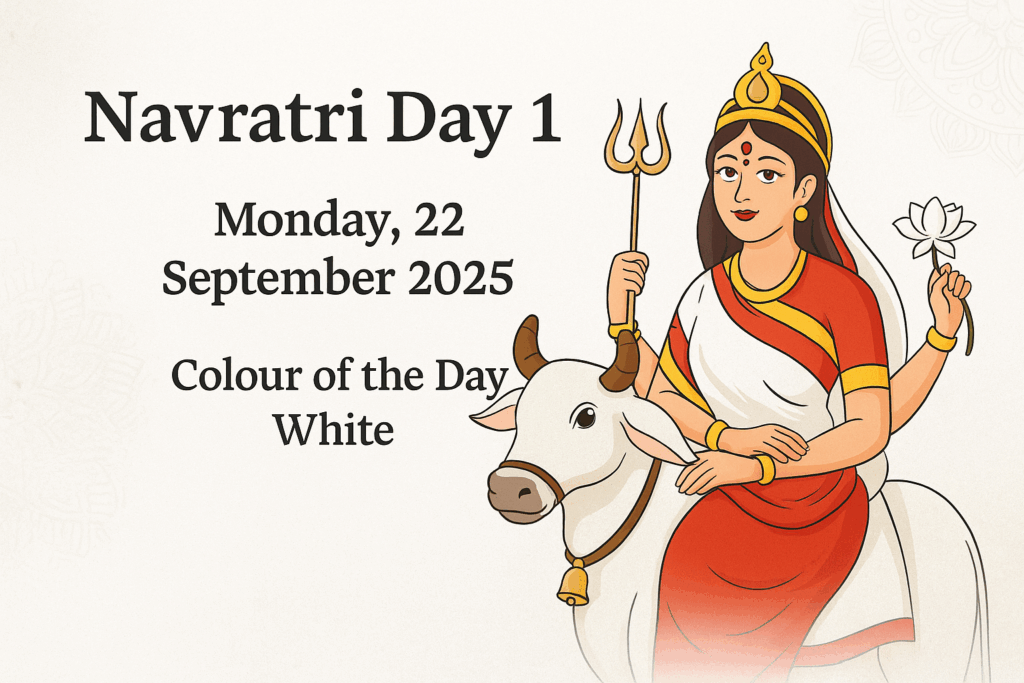
The first day of Shardiya Navratri 2025 falls on Monday, 22 September, and is dedicated to Goddess Shailaputri, the daughter of the mountains. This day marks the spiritual beginning of the nine-day festival, setting the tone for transformation, discipline, and inner strength. The colour of the day is White, representing purity, peace, and new beginnings.
For millions of devotees across India and the world, the celebration begins not just with rituals and fasting, but with intentional symbolism—where colour, prayer, and mythology intertwine. Day 1 is not just the start of Navratri; it is a return to the root of Shakti itself.
Who is Goddess Shailaputri and why is she worshipped on the first day of Navratri?
Goddess Shailaputri is the first of the Navadurga—the nine manifestations of Goddess Durga. Her name literally means “Daughter of the Mountains” (Shaila = mountain, Putri = daughter). She is regarded as a form of Parvati, born to King Himavat, the personification of the Himalayas. Shailaputri holds a trident (Trishul) in one hand and a lotus in the other, and she rides a bull named Nandi.
Spiritually, Shailaputri is believed to embody the grounding and stabilising energy needed to start any spiritual journey. She is the root Muladhara Chakra in yogic tradition, representing the foundation of inner strength and resilience.
Worshipping Shailaputri is said to awaken the devotee’s own potential for discipline, devotion, and strength. Her story reminds followers of patience, humility, and power born from simplicity.
Why is the colour white associated with Goddess Shailaputri on Day 1 of Navratri 2025?
White is the designated colour for Day 1 of Navratri 2025, symbolising peace, clarity, and divine consciousness. It reflects the tranquil energy of Goddess Shailaputri, who encourages devotees to begin the festival with a clean slate—both spiritually and emotionally.
Wearing white on this day isn’t just a visual choice. In Hindu traditions, white is associated with sattva guna—the mode of purity and balance. It helps devotees shift their attention inward and surrender ego, paving the way for deeper connection with the divine.
For those fasting or observing rituals, white represents discipline and sacred resolve. When the entire household wears white or decorates their altar in white flowers, cloths, or candles, it creates an energetic harmony that is both calming and spiritually uplifting.
What rituals are performed on the first day of Navratri in 2025?
Day 1 of Navratri begins with Ghatasthapana, a sacred ritual symbolising the invocation of Goddess Durga. A kalash (sacred pot) filled with water and covered with coconut and mango leaves is placed on a bed of soil or grains and worshipped. This kalash symbolises fertility, abundance, and the cosmic womb from which all life emerges.
Devotees chant Durga Saptashati or Devi Mahatmya, perform aarti, and offer white flowers, fruits, and sweets as part of their daily prayer. Many begin their Navratri fast from this day, often consuming only sattvic food or limiting meals to one or two per day.
Offerings to Goddess Shailaputri on this day include:
- White jasmine or white lotus flowers
- White sweets like coconut laddoos or milk-based prasad
- Pure water, camphor, and ghee diya (lamp) to symbolise light and clarity
For home altars or Golu displays, using white drapes, white marigold garlands, or silver decor elements helps align the space with Day 1’s divine energy.
How can devotees celebrate Navratri Day 1 at home or work using white?
Beyond rituals, devotees often express devotion through attire and ambiance. Wearing white—whether a sari, kurta, or even a white scarf—is the simplest yet most powerful way to resonate with the day’s theme.
At home, families may decorate with white rangoli, place white flowers at their doorway, or light white candles to invite peace. Offices and schools increasingly observe colour-coordinated days, and white-themed decor or dress codes mark a collective beginning of the festive spirit.
Women may accessorise their white outfits with silver or pearl jewellery, while men often choose white angavastrams or traditional kurtas. The point is not fashion—but intention. White connects the worshipper with the stillness and clarity of Shailaputri’s form.
What is the deeper symbolic meaning of beginning Navratri with Shailaputri?
The journey through Navratri mirrors an inner transformation. Goddess Shailaputri, as the root of the Navadurga, represents the origin of willpower, the grounding energy that prepares the mind and body for spiritual elevation.
Her bull Nandi symbolises loyalty and stability. In spiritual psychology, beginning with Shailaputri is like stabilising the base before ascending the chakras. Her message is simple but profound: one must stay rooted in values, integrity, and discipline before embracing divine power.
This makes Day 1 not just a starting point, but a foundation—spiritually and emotionally.
What can devotees keep in mind for Day 1 and the days ahead?
Day 1 is an invitation to slow down and turn inward. Whether one is fasting, attending garba events, or simply lighting a lamp at home, the intention of spiritual alignment is more important than the scale of the ritual.
As Goddess Shailaputri is worshipped, devotees are reminded to embrace humility, patience, and inner stillness. By beginning with white, they symbolically begin with a blank page, ready to receive the energy of the divine feminine across all her forms in the days to come.