Bathukamma is one of Telangana’s most colourful and distinctive festivals, transforming homes, streets and community spaces into gatherings filled with seasonal flowers, traditional songs, colourful sarees, jewellery and celebration.
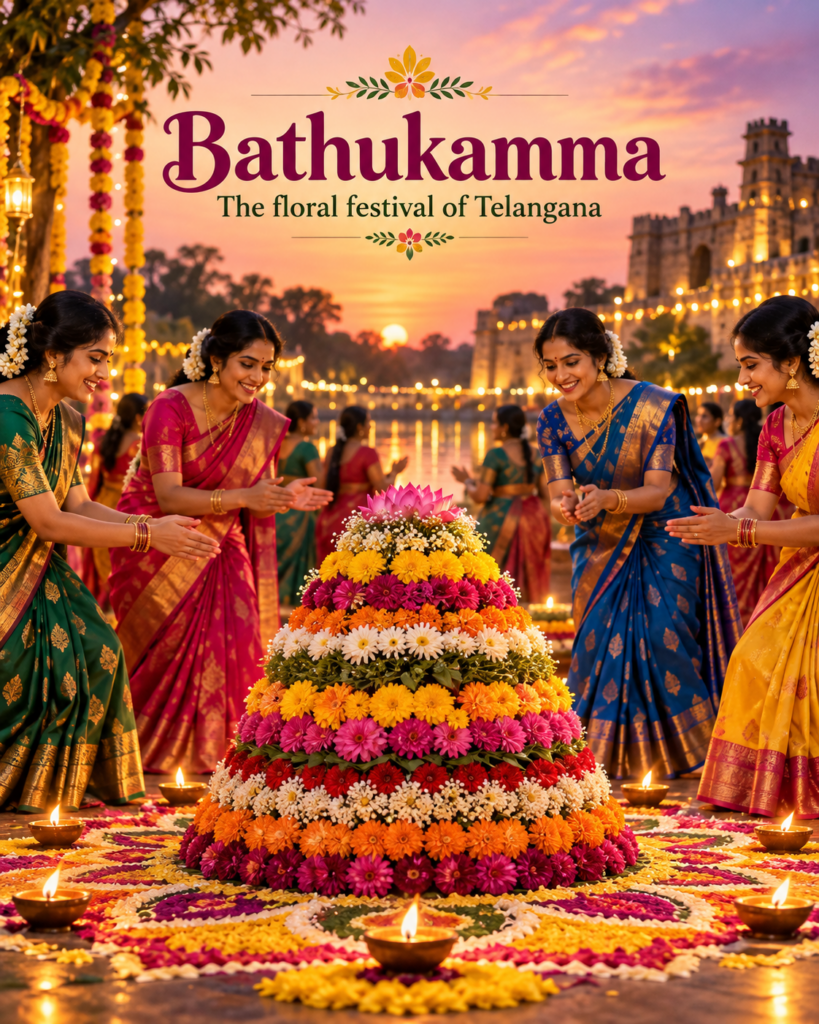
Unlike many festivals centred mainly around a temple or household puja, Bathukamma is especially associated with women coming together as a community. They arrange flowers into beautiful tiered structures, gather around them in circles, sing traditional songs and celebrate with family, neighbours and friends.
The festival has become an important symbol of Telangana’s cultural identity. Official Telangana sources describe Bathukamma as a celebration of the relationship between nature, water, people and the collective spirit of women.
What does the word Bathukamma mean?
Bathukamma is commonly interpreted as “Mother Goddess come alive.” The floral arrangement itself is worshipped as a representation of Goddess Gauri, and the festival is closely connected with femininity, life, prosperity and nature.
The beautifully stacked flowers are therefore much more than decoration. For devotees, Bathukamma represents the Goddess in floral form and becomes the centre of the evening’s prayers, songs and celebrations.
Why is Bathukamma celebrated in Telangana?
Bathukamma takes place during the latter part of the monsoon season, when many seasonal wildflowers bloom naturally across Telangana.
Flowers such as Tangedu, Gunugu, Banti, Chamanti and other locally available varieties are traditionally used to create Bathukamma arrangements. Tangedu is particularly important and is also Telangana’s official state flower.
The festival therefore connects religious devotion with the seasonal landscape of Telangana.
Official state descriptions also emphasise Bathukamma’s historic, ecological, social and religious significance. It celebrates nature while bringing families and neighbourhoods together in a shared tradition.
Why do women celebrate Bathukamma so enthusiastically?
One of the most beautiful aspects of Bathukamma is that women are not simply participants in the festival. They are at the centre of the celebration.
Women and girls dress in colourful sarees, half-sarees, lehengas and traditional jewellery before gathering with their Bathukammas in neighbourhoods and community spaces.
The floral arrangements are placed together, and women form a circle around them. They clap, sing and move rhythmically around the flowers, creating an atmosphere that is devotional but also joyful and social.
Telangana Tourism describes the gathering as creating a human circle of unity, love and sisterhood. It also notes the tradition of married women returning to their parents’ homes during the festival period, giving families another opportunity to reunite and celebrate together.
That helps explain why Bathukamma often feels different from an ordinary religious observance. It is simultaneously a festival of the Goddess, flowers, family, friendship, women and Telangana culture.
How is a Bathukamma made?
Creating the Bathukamma itself is one of the most enjoyable parts of the festival.
Seasonal flowers are gathered and carefully arranged in circular layers, generally building upward into a beautiful tiered or temple-like shape. Different flower colours are alternated to create a striking pattern.
Telangana Tourism describes families sitting together to arrange flowers row by row in a brass plate called a taambalam, forming circular layers in different colours.
Because every combination of flowers is slightly different, each Bathukamma develops its own appearance.
For children and younger family members, helping select, separate and arrange the flowers can also become a way of learning the tradition from older generations.
Why are flowers so important in Bathukamma?
Bathukamma arrives at a time when Telangana’s landscape has been refreshed by monsoon rains and seasonal flowers are abundant.
Traditional Bathukamma therefore uses flowers that are naturally associated with the region and season rather than relying only on decorative artificial materials.
The Telangana government describes Bathukamma as expressing an inherent relationship between earth, water and human beings, while Telangana Tourism highlights the flowering landscape that accompanies the festival.
This connection with local flowers is one reason Bathukamma has remained such a distinctive regional celebration even as it has spread to Telangana communities living elsewhere in India and overseas.
Why do women sing while circling Bathukamma?
The songs are another major part of the celebration.
Bathukamma songs are not limited to a single religious story. Telangana’s official culture pages note that the songs can draw from Puranic stories, history and even social and political developments of the region.
That makes the singing an important form of cultural memory.
Women singing together also transforms the festival into a community event. Older songs are passed from one generation to another, while women and girls participate together rather than simply watching a ritual being performed.
The repeated circular movement around the Bathukamma, combined with clapping and group singing, creates the distinctive atmosphere for which the festival is known.
What are the nine days of Bathukamma?
Bathukamma is traditionally observed across nine days, with different names and food traditions associated with each stage.
The sequence commonly recognised by Telangana government sources includes Engili Pula Bathukamma, Atkula Bathukamma, Muddapappu Bathukamma, Nanabiyyam Bathukamma, Atla Bathukamma, Aligina Bathukamma, Vepakayala Bathukamma, Venna Muddala Bathukamma and finally Saddula Bathukamma.
The final celebration is the grandest.
In 2026, the Telangana government calendar lists Saddula Bathukamma on Sunday, October 18. Vijayadashami follows on October 20.
What happens on Saddula Bathukamma?
Saddula Bathukamma is the grand culmination of the festival.
Families prepare larger floral arrangements, women dress in festive clothing and jewellery, and communities gather for the final evening of singing and celebration.
After the gathering, the Bathukammas are traditionally carried to nearby water bodies for immersion. Official Telangana cultural descriptions identify this immersion as the concluding stage of the festival.
For many families, the occasion becomes one of the year’s most memorable community gatherings.
Bathukamma is also a celebration of women and community
The popularity of Bathukamma cannot be explained only through ritual.
For many women, it is also an opportunity to dress traditionally, wear jewellery and bangles, meet relatives and friends, sing together, create something beautiful with flowers and participate visibly in community life.
That combination of devotion and celebration gives Bathukamma much of its energy.
The festival brings together grandmothers, mothers, daughters, sisters, friends and neighbours, allowing traditions to move naturally from one generation to the next.
It is this collective participation that turns a floral arrangement into something much larger: a symbol of belonging and cultural identity.
What jewellery and bangles are worn for Bathukamma?
Traditional attire is an important visual part of Bathukamma celebrations.
Women commonly wear colourful sarees with jewellery, while younger girls may choose half-sarees, lehengas or other festive traditional outfits. Telangana government festival information specifically highlights jewellery and accessories as part of traditional Bathukamma attire.
Colourful silk-thread bangles, kundan bangles, jhumkas, necklaces and floral accessories can complement Bathukamma outfits beautifully.
If you are planning handmade bangles for Bathukamma or Dussehra, booking them early is helpful because customised colour combinations require preparation time.
Visit SilkThreadMaterials.com or DM @jewellerymakingmaterials for handmade bangle and jewellery enquiries.
Why Bathukamma continues to remain special
Bathukamma has survived because it is not only something people watch.
Families make the Bathukamma. Women sing the songs. Communities gather around it. Children learn the flowers and traditions. Everyone becomes part of the celebration.
That participation keeps the festival alive.
For Telangana families, Bathukamma remains a beautiful expression of flowers, femininity, nature, family relationships, community spirit and cultural pride.